
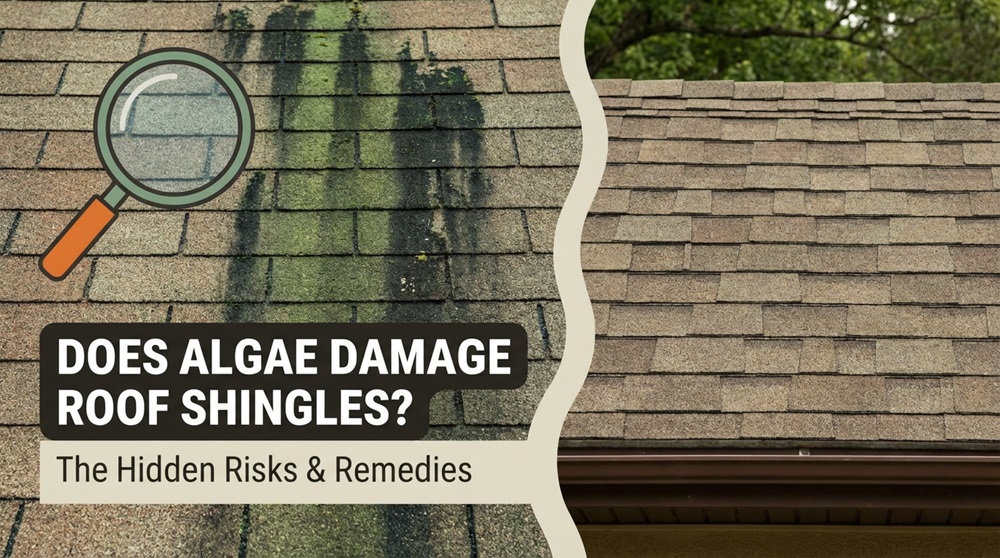
Yes, algae damages roof shingles—but not in the way most homeowners think. The black streaks you see aren’t just cosmetic. They’re colonies of Gloeocapsa magma (a type of cyanobacteria) that feed on the limestone fite in asphalt shingles, reduce your roof’s reflectivity, and can shorten shingle lifespan by 10-15% if left untreated for years.
Asphalt Roofing Manufacturers Association (ARMA) research confirms that algae growth affects both appearance and performance. Here’s what actually happens to your roof and how to address it effectively.
How Algae Actually Damages Roof Shingles?
Understanding the organism: What most people call “roof algae” is primarily Gloeocapsa magma, a cyanobacterium (blue-green algae) that thrives in humid environments. It appears as dark streaks or staining, typically starting on north-facing or shaded roof sections where moisture lingers longest.
Shingle Material Degradation
Limestone consumption: Asphalt shingles contain calcium carbite (limestone) filler, which algae metabolize as a nutrient source. Over years of growth, this slowly depletes the mineral content that provides shingle structure and granule adhesion.
Granule loss acceleration: Research from the Oak Ridge National Laboratory shows algae-covered shingles lose granules 10-20% faster than clean shingles. The algae colonies create a biofilm that retains moisture against the shingle surface, accelerating granule-to-asphalt bond breakdown.
Moisture retention: Algae colonies hold moisture against the shingle surface longer after rain. This extended wet-dry cycling stresses the asphalt, causing premature aging, curling, and cracking—particularly in shingles over 10 years old.
Thermal Performance Reduction
Reduced reflectivity: Clean asphalt shingles reflect 5-25% of solar radiation depending on color. Algae-covered shingles drop to 3-8% reflectivity regardless of original color because the dark algae biofilm absorbs heat.
Increased cooling costs: Studies from Florida Solar Energy Center document 10-15% higher roof surface temperatures on algae-covered sections compared to clean areas on the same roof. This translates to measurable increases in attic temperature and cooling load.
Accelerated aging: The combination of moisture retention and elevated temperature accelerates asphalt oxidation—the primary aging mechanism in shingles. Heavily algae-covered roofs age 15-25% faster than clean roofs in the same climate.
Structural and Safety Concerns
Reduced slip resistance: Algae-covered shingles become extremely slippery when wet. OSHA and roofing industry safety data identify algae and moss growth as contributing factors in roof-related slip and fall incidents.
Underlying damage masked: Algae growth can hide developing problems—cracked shingles, missing granules, flashing failures—making regular inspection difficult and delaying necessary repairs.
Secondary growth: Algae creates conditions favorable for moss and lichen colonization. These organisms cause more severe damage, with moss roots actually lifting shingle edges and creating leak pathways.
Reasons why Algae Grows on Your Roof?
Humidity and moisture: Algae requires moisture to survive. Roofs in humid climates (Southeast, Pacific Northwest, coastal areas) or sections that stay damp (north-facing slopes, shaded areas, near trees) are most susceptible.
Organic debris: Leaves, pollen, and dirt accumulation provide additional nutrients and retain moisture, accelerating algae establishment.
Airborne spores: Gloeocapsa magma spreads via airborne spores. If neighboring roofs have algae, spores will eventually reach yours regardless of preventive measures.
Shingle composition: Shingles with higher limestone filler content (common in budget shingles) provide more algae food source than premium shingles with lower limestone content.
Reduced sun exposure: Direct sunlight and heat inhibit algae growth. Shaded roof sections and north-facing slopes grow algae faster because they stay cooler and damper.
How to Remove Algae from Roof Shingles?
Safe, effective cleaning methods that won’t damage shingles:
Bleach Solution Process (Most Effective)
Recommended mixture: 50% household bleach (sodium hypochlorite) and 50% water. This is the cleaning method recommended by ARMA and most shingle manufacturers.
Application process:
- Wet surrounding plants and landscaping with plain water before starting—bleach solution can damage vegetation
- Apply solution to dry roof using pump sprayer or garden sprayer
- Work on cool, overcast day to prevent rapid evaporation before solution works
- Let solution sit 15-20 minutes—visible algae will begin to lighten
- Rinse with low-pressure water (garden hose, not pressure washer)
- Repeat if necessary for heavy growth
Never pressure wash asphalt shingles. High-pressure water strips granules, voiding manufacturer warranties and dramatically shortening shingle life. Garden hose pressure (40-60 PSI) is sufficient for rinsing.
Cost: DIY cleaning costs $20-50 in materials for average roof. Professional cleaning runs $300-700 depending on roof size and algae severity.
Use Commercial Roof Cleaning Products
Oxygen bleach alternatives: Products like Wet & Forget, Spray & Forget, or Bio-Advanced Moss and Algae Killer use oxygen bleach or quaternary ammonium compounds instead of chlorine bleach.
Advantages: Less harsh on plants, no chlorine odor, some products require no rinsing
Disadvantages: Slower acting (may take 2-4 weeks for full effect), typically more expensive, may require multiple applications
Cost: $25-60 per container treating 750-2,000 square feet
Call for Professional Roof Cleaning
When to hire professionals:
- Steep roof pitch (over 6:12) creating safety concerns
- Two-story or higher homes
- Heavy moss or lichen growth (not just algae)
- Large roof area requiring extensive ladder work
- Homeowner preference for guaranteed results
Professional methods: Soft washing (low-pressure application of cleaning solution) is industry standard. Reputable cleaners avoid pressure washing and use shingle-safe chemicals.
Cost: $300-700 for average single-story home, $500-1,200 for two-story or complex roofs
Frequency: In high-humidity climates, expect to clean every 2-4 years even with preventive measures.
How you Preventing Future Algae?
Method 1: Zinc or Copper Strips
How they work: Metal strips installed along the ridge oxidize when wet, releasing metal ions that wash down the roof and inhibit algae growth. Zinc is most common; copper is more effective but more expensive.
Installation: Strips attach under shingles along ridge cap using roofing nails. Exposed metal portion (typically 2-4 inches) provides the active surface.
Effectiveness: Creates a “clean zone” extending 10-15 feet below the strip. May not fully protect lower sections of long roof runs.
Cost: $2-4 per linear foot for zinc strips, $5-10 for copper. Professional installation adds $100-300 labor.
Lifespan: Zinc strips last 10-20 years, copper strips 20-40 years.
Method 2: Algae-Resistant Shingles
Technology: Shingles manufactured with copper granules blended into the surface. As rainwater washes over the roof, small amounts of copper leach out and prevent algae growth.
Major products: Most manufacturers now offer AR (algae-resistant) versions of their shingle lines:
- Owens Corning Duration (StreakGuard protection)
- GAF Timberline HDZ (StainGuard Plus)
- CertainTeed Landmark (StreakFighter)
- Atlas StormMaster (Scotchgard Protector)
Effectiveness: Manufacturer warranties against algae staining typically cover 10-15 years. Real-world performance shows 15-25 years of algae resistance in most climates.
Cost premium: $10-30 per square (100 sq ft) over standard shingles—minimal when installing a new roof.
Recommendation: When re-roofing, always choose algae-resistant shingles if you live in a humid climate. The cost difference is negligible compared to repeated cleaning costs over the roof’s life.
Method 3: Environmental Modifications
Trim overhanging trees: Increase sunlight and airflow to roof surface. Maintain 6-10 feet clearance from roof edge.
Clean gutters regularly: Clogged gutters cause water backup and splashing that keeps roof edges damp.
Remove debris promptly: Leaves, pine needles, and organic matter trap moisture and provide algae nutrients.
Improve attic ventilation: Proper ventilation reduces roof surface moisture and temperature differentials that promote algae growth.
Frequently Asked Questions
Does algae damage void my shingle warranty?
No, algae growth is considered normal weathering and doesn’t void manufacturer warranties. However, improper cleaning methods (pressure washing, harsh chemicals) can void warranties. Always check manufacturer cleaning recommendations before treating your roof.
How quickly does algae damage shingles?
Visible algae staining typically appears within 2-5 years of spore colonization in humid climates. Measurable shingle damage (accelerated granule loss, reduced reflectivity) develops over 5-10 years of heavy algae coverage. A single cleaning can reverse most damage if caught within the first few years.
Can I prevent algae completely?
No, you can only slow and manage growth. Algae spores are airborne and will eventually reach any roof. Algae-resistant shingles, zinc/copper strips, and regular maintenance minimize growth but don’t eliminate it entirely in humid climates.
Is the black staining always algae?
Usually, but not always. Black streaking is typically Gloeocapsa magma algae. However, actual dirt/pollution, mold, or mildew can cause similar appearance. Moss (green, fuzzy growth) and lichen (green/gray crusty patches) are different organisms requiring different treatment approaches.
Should I clean my roof myself or hire a professional?
For single-story homes with low-pitch roofs and light algae growth, DIY cleaning is practical and cost-effective. For steep roofs, two-story homes, heavy growth, or safety concerns, professional cleaning is worth the $300-700 cost for safety and guaranteed results.
How often should I clean algae from my roof?
In humid climates (Southeast, Pacific Northwest), expect cleaning every 2-4 years. In drier climates, you may go 5-10 years between cleanings. Algae-resistant shingles and zinc/copper strips extend intervals significantly.
What color roof hides algae best?
Dark-colored roofs (charcoal, black, dark brown) hide algae staining best. However, dark roofs run hotter, potentially accelerating algae-related damage even though staining is less visible. Light-colored algae-resistant shingles provide better thermal performance and genuine algae prevention rather than just hiding the problem.
Bottom Line
Algae does damage roof shingles—gradually but measurably. Left unchecked for years, it accelerates granule loss, reduces reflectivity, and shortens shingle lifespan. The good news: simple cleaning reverses most damage, and preventive measures (algae-resistant shingles, zinc strips) dramatically reduce future growth.
If you’re seeing black streaks now, a $300-500 professional cleaning or weekend DIY project solves the immediate problem. If you’re re-roofing soon, spend the extra $10-30 per square for algae-resistant shingles and avoid the issue for 15-25 years.
Don’t ignore algae—but don’t panic about it either. Address it, prevent it, and your shingles will last their full expected lifespan.