
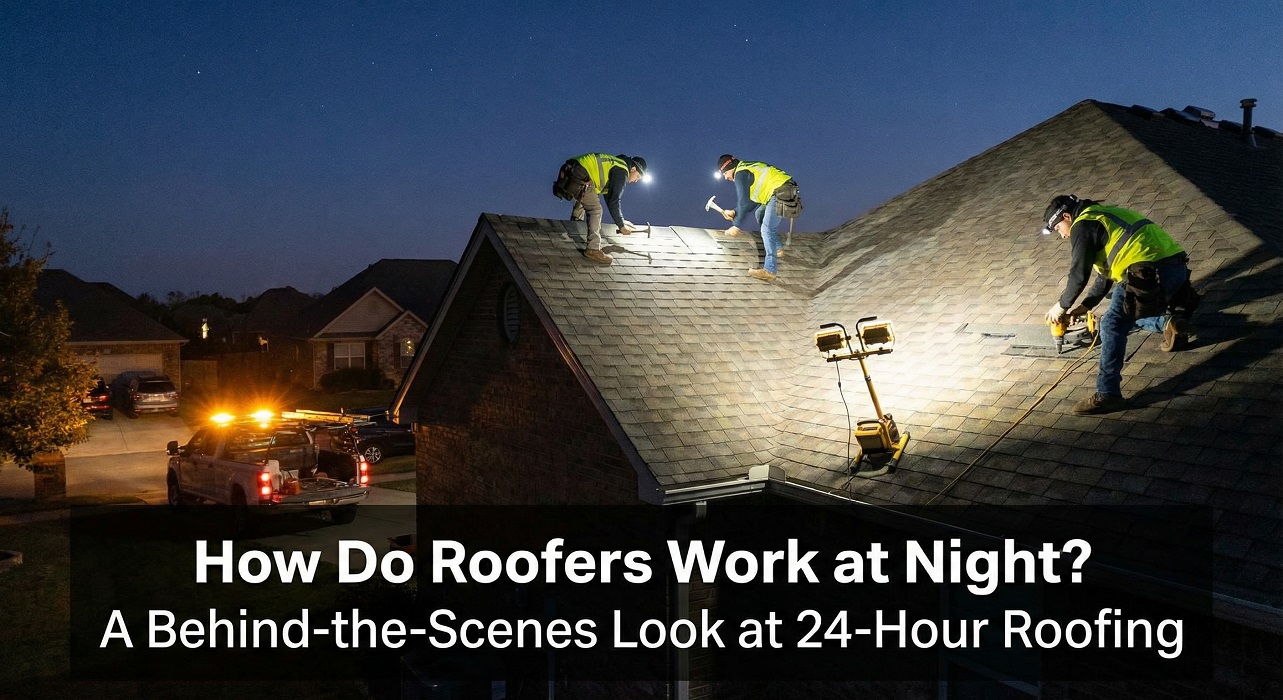
Most professional roofers don’t work at night, and for good reason. After 20+ years in the roofing industry, I can count on one hand the number of legitimate nighttime roofing jobs I’ve done. The exceptions are emergency tarping after storm damage or critical leak containment—not full roof installations or replacements.
Here’s the reality: Any roofing company offering routine night roofing work is either desperate for business, cutting corners on safety, or doesn’t understand industry standards. OSHA regulations, insurance liability, municipal noise ordinances, and basic safety all point to the same conclusion—roofing belongs in daylight.
But emergency situations happen. When they do, here’s what separates professional emergency roof work from dangerous improvisation.
When Night Roofing Actually Happens?
Let me clarify what “night roofing” realistically means in the professional roofing industry.
Legitimate Night Roofing Scenarios
Emergency leak containment (90% of night roofing work):
After severe storms, tornados, hurricanes, or unexpected roof failures, emergency crews perform temporary protection—primarily tarp installation. This isn’t roofing; it’s damage control to prevent further water intrusion until daylight allows proper assessment and repair.
I’ve responded to hundreds of these calls. A tree through the roof at 11 PM, a tornado that peeled back shingles during dinner, ice dam failure flooding an attic at 2 AM. These situations can’t wait for morning—every hour of exposure means more interior damage.
Critical commercial situations (rare):
Occasionally, 24-hour manufacturing facilities, data centers, or hospitals need immediate roof access for emergency HVAC repairs, equipment installation, or leak containment that can’t interrupt operations. Even then, we’re talking about targeted repair or access work, not full roof replacement.
Large commercial projects with off-hours requirements:
Some big-box retailers, shopping malls, or occupied office buildings schedule specific phases during overnight hours to avoid customer/employee disruption. But this represents less than 1% of roofing work and requires extensive planning, permits, additional lighting, and safety measures that double or triple labor costs.
What Night Roofing Is NOT
Not routine installations: No reputable contractor does standard residential re-roofs at night. The quality, safety, and liability issues make it unviable.
Not cost-effective: Night work typically costs 150-200% more due to lighting requirements, safety measures, insurance riders, and premium labor rates.
Not better quality: Despite what some companies claim, nighttime installations produce inferior results. You can’t see color matching, proper alignment, or defect identification in artificial light.
Not legal everywhere: Many municipalities have noise ordinances prohibiting construction work between 7 PM and 7 AM. Violating these can result in fines and work stoppages.
Why Professional Roofers Avoid Night Work?
Safety Hazards Multiply in Darkness
Fall risk increases dramatically. According to OSHA data, roofing already accounts for one-third of all construction falls. Inadequate lighting multiplies that risk exponentially.
Depth perception disappears in artificial lighting. What looks like a flat surface might have a 2-inch height difference. On a steep roof, that misjudgment causes falls.
Shadows create invisible hazards. Even with flood lighting, shadows hide roof penetrations, elevation changes, damaged sections, and debris. I’ve seen experienced roofers step into shadows thinking it was solid roof—it was a skylight.
Fatigue factor. Most night roofing happens after roofers have already worked a full day. Tired roofers make mistakes. On roofs at night, mistakes cause hospitalizations.
Quality Suffers Significantly
You can’t see what you’re doing. Shingle color matching, proper alignment, granule coverage, sealant application, flashing integration—all require visual precision. Artificial light doesn’t provide the spectrum or coverage for quality control.
Adhesive and sealant performance. Many roofing adhesives and sealants cure based on UV exposure and temperature. Night application with cooler temperatures and no UV exposure means improper curing. Shingle adhesive strips may not activate properly.
Material temperature issues. Asphalt shingles should be installed at temperatures between 40-85°F. Night temperatures, especially in spring and fall, drop below optimal ranges. Cold shingles crack during nailing and don’t seal properly.
Moisture problems. Evening dew forms on roof surfaces as temperatures drop. Installing over damp surfaces traps moisture, leading to rot, mold, and adhesion failure. This happens constantly in night roofing.
Inspection is nearly impossible. Quality roofing requires constant inspection—checking each course for proper alignment, verifying fastener placement, ensuring no exposed adhesive or gaps. You can’t do this adequately at night.
Legal and Insurance Complications
OSHA regulations become harder to meet. While OSHA doesn’t explicitly ban night roofing, meeting illumination standards (minimum 5 foot-candles for general construction, 10+ foot-candles for detailed work) across an entire roof is difficult and expensive.
Insurance liability increases. Many contractor insurance policies exclude or limit coverage for night work due to elevated risk. If a roofer is injured during unauthorized night work, you as the property owner could face liability.
Workers’ compensation implications. Some states have different workers’ comp rates or requirements for night construction work, increasing costs and liability.
Building permit restrictions. Many jurisdictions require daylight work hours for permitted roofing projects. Night work can violate permit conditions, risking fines and failed inspections.
Noise ordinances. Residential roofing creates 80-95 decibels of noise (compressors, nail guns, material handling, worker communication). Most residential areas prohibit this noise level after 7-8 PM. Violations result in fines, neighbor complaints, and police involvement.
Emergency Night Roofing: How It’s Done Right
When emergency roof work is genuinely necessary at night, here’s the professional standard.
Proper Lighting Requirements
Minimum illumination standards: OSHA requires 5 foot-candles for general construction areas and 10 foot-candles for areas where detailed work occurs. For roofing, this means multiple light sources providing overlapping coverage with no dark spots or harsh shadows.
Professional lighting setup I use for emergency work:
LED construction light towers (not regular floodlights) providing 360-degree coverage. These produce 50,000+ lumens and stand 8-12 feet high, illuminating large roof areas evenly. Cost: $150-400 per night rental, and you need 2-4 units depending on roof size.
Headlamps for each crew member (minimum 500 lumens, preferably 1,000+) providing task lighting. These are essential for close-up work that overhead lighting can’t adequately illuminate.
Perimeter lighting around roof edges, valleys, penetrations, and elevation changes. Battery-powered LED work lights positioned to eliminate shadows in critical areas.
The goal isn’t brightness—it’s even, shadow-free coverage. Too much light creates glare and harsh shadows. Too little leaves dark spots. Professional emergency lighting costs $500-1,200 to set up properly, which is why night work is expensive.
Enhanced Safety Measures
Full fall protection is non-negotiable. If I’m putting a crew on a roof at night, every single person is in a harness with dual lanyards tied off to code-compliant anchor points. During the day, we might use alternative fall protection on certain low-slope roofs; at night, it’s harnesses only.
Spotter/safety person on the ground. Night emergency work requires a dedicated safety observer who isn’t performing roofing tasks—they’re watching crew movements, monitoring for hazards, and ready to call for help if something goes wrong.
Limited scope of work. Emergency night work focuses on containment only—tarping, temporary patching, stopping active leaks. We don’t do full installations, replacements, or permanent repairs at night. Those wait for daylight when proper work is possible.
Crew size restrictions. Fewer people on the roof at night reduces collision risk and makes safety monitoring easier. Maximum 2-3 workers on residential roofs for emergency tarping.
Communication protocols. Constant verbal communication is mandatory. Crew members announce movements, tool use, and position changes. Radio communication for larger commercial roofs.
Electrical Safety
Temporary power setup requires licensed electrician consultation for anything beyond basic extension cords. Professional emergency services use generator-powered distribution boxes with ground fault circuit interrupters (GFCI) on every circuit.
Cable management is critical. Every extension cord must be routed safely, secured to prevent tripping, and rated for outdoor/construction use (minimum 12-gauge for power tools). Overhead cable routing is preferred where possible.
No daisy-chaining extension cords. Each tool/light runs on its own properly-rated circuit from the distribution source. Overloaded circuits cause voltage drops (dimming lights at critical moments) and fire risk.
Generator placement: Minimum 20 feet from structure, on stable ground, with proper ventilation. Carbon monoxide from generators has killed workers and homeowners during emergency roof work.
The Real Cost of Night Roofing
Emergency tarping service (what most “night roofing” actually is): $300-1,200 depending on roof size, damage extent, and time of night. This is temporary protection only.
Legitimate planned night roofing (commercial, off-hours requirement): 150-250% premium over standard daytime pricing. A $10,000 daytime roof job costs $15,000-25,000+ at night.
Why the premium:
- Equipment rental (lighting, generators): $500-2,000
- Labor premium (night/hazard pay): 1.5-2x standard rates
- Additional safety equipment and personnel
- Insurance riders for night work
- Permit modifications (if allowed)
- Inefficiency factor (work takes 30-50% longer)
Most homeowners abandon night roofing plans when they see the real cost. And they should—the premium rarely justifies the convenience.
Day vs. Night Roofing Reality
What the “Convenience” Argument Misses
Commercial buildings: The argument is that night roofing avoids business disruption. But modern roofing techniques (sectional completion, crane material delivery, proper tarping between phases) allow daytime work with minimal interruption for 95% of commercial roofs.
The noise happens either way. Nail guns, compressors, material handling, and debris removal create the same noise regardless of when it occurs. Moving that noise to nighttime just shifts the disruption to residents instead of employees—and violates most noise ordinances.
Inspection and warranty issues. Building inspectors work during the day. If your night roofing job needs inspection (which permitted work does), you’re scheduling daytime inspections anyway, eliminating the “off-hours convenience” entirely.
Manufacturer warranties often require daylight installation. Many shingle manufacturers specify installation during daylight hours as a warranty condition. Night installation can void your 25-30 year material warranty, leaving you with no recourse for premature failure.
When You Actually Need Emergency Night Service
Active water intrusion causing ongoing damage: Tarping and temporary containment make sense and can save thousands in water damage.
Structural exposure after storm damage: Securing exposed roof structure before weather changes is legitimate emergency work.
Total roof failure (rare but happens): Catastrophic damage requiring immediate structural safety measures can’t wait.
Everything else can and should wait for daylight. A small leak that’s been dripping for weeks doesn’t become a night emergency just because you finally noticed it.
Finding Emergency Roofing Services
Red Flags of Disreputable Night Roofers
Companies advertising “24/7 roof replacement” as a selling point. Legitimate roofers offer 24/7 emergency response (tarping, damage assessment), not full installations.
Prices that seem too good for night work. If they’re not charging a significant premium, they’re either not providing proper safety measures or they’re cutting corners elsewhere.
No mention of lighting, safety equipment, or permits. Professional emergency services explain exactly what measures they take for safe night work.
Pressure to do permanent repairs immediately. Reputable contractors tarp/contain the emergency at night, then return in daylight for proper assessment and permanent repair.
Questions to Ask Emergency Roofing Companies
“What exactly will you do tonight vs. what waits for daylight?” The answer should be: temporary containment tonight, permanent repair after daylight assessment.
“What lighting and safety equipment do you provide?” They should describe specific equipment (light towers, generators, fall protection), not vague “we bring lights.”
“Are your crews trained and insured for night work?” Verify they carry proper insurance with no night work exclusions.
“What permits or permissions are required?” They should know local ordinances and permit requirements.
“What’s your emergency service premium?” Legitimate services charge more for night emergency calls—it’s honest pricing for increased cost and risk.
Noise Ordinances and Legal Considerations
Most residential areas prohibit construction noise between 7-10 PM and 6-7 AM depending on local ordinances. Commercial areas may allow extended hours but rarely 24/7 construction.
Typical noise ordinances limit residential areas to 55-65 decibels after 10 PM. Roofing work produces 80-95 decibels. That’s not close—it’s a flagrant violation.
Penalties for violations: Fines ranging from $250-2,500 per violation (each complaint can be a separate violation). Cease work orders. Permit revocation.
Your liability as property owner: If you hire someone for night roofing that violates local ordinances, you can be held liable along with the contractor.
Homeowners associations (HOAs): Most have specific construction hour restrictions more stringent than municipal codes. Violating HOA rules can result in fines and legal action.
My Professional Recommendation
Don’t plan night roofing for convenience. The cost, quality, safety, and legal issues make it a poor choice. Modern roofing can be done during business hours with minimal disruption using proper planning and techniques.
Do use emergency night services when legitimately necessary. Storm damage with active water intrusion requires immediate tarping. Just understand you’re paying for temporary containment, not permanent repair.
Verify any company offering night roofing services. Most reputable roofers will try to talk you out of night work and explain why daylight is better. If they’re enthusiastically pushing night work, question their motives.
Plan roof work during optimal seasons. Late summer through fall provides long daylight hours, moderate temperatures, and stable weather. Proper scheduling eliminates the temptation to resort to night work.
For commercial buildings, sectional scheduling works better. Complete one section at a time during business hours rather than attempting wholesale night roofing. Less disruption, better quality, lower cost.
Quick FAQ
Do professional roofers work at night?
Rarely, and only for emergencies. Professional roofing companies offer 24/7 emergency response (tarping, damage containment), not routine night installations.
Is night roofing safe?
It’s significantly more dangerous than daytime work, with higher fall risk, visibility issues, and fatigue factors. Only emergency containment work justifies the increased risk.
How much does emergency night roofing cost?
Emergency tarping: $300-1,200. Planned night roofing work (rare): 150-250% premium over daytime pricing.
Can roofers legally work at night in my area?
Depends on local ordinances. Most residential areas prohibit construction noise after 7-10 PM. Check with your city/county building department and HOA.
What’s the difference between emergency tarping and night roofing?
Emergency tarping is temporary damage containment (legitimate night service). Night roofing implies full installation or replacement (rarely done by reputable contractors).
Will night roofing void my warranty?
Possibly. Many shingle manufacturers specify daylight installation. Night work may void material warranties and affect contractor workmanship guarantees.
Why do some companies advertise 24/7 roofing?
They mean emergency response availability, not that they perform quality installations at night. If they actually mean 24/7 installations, it’s a red flag.
Bottom Line
Real roofing happens during daylight. The industry standard exists for good reasons: safety, quality, legal compliance, and basic physics of how roofing materials perform.
Night “roofing” is really emergency response—tarping storm damage, containing leaks, preventing further water intrusion until proper daytime repair is possible.
If someone is offering you routine night roofing:
- Question their safety practices
- Verify their insurance covers night work
- Check local noise ordinances
- Get the real cost (should be 150-250% premium)
- Ask yourself if it’s truly necessary
In 20+ years, I’ve never seen a situation (outside genuine emergencies) where night roofing was the best solution. Better planning, modern techniques, and proper scheduling solve 99% of situations people think require night work.
When you do have a genuine emergency—tree through the roof, tornado damage, catastrophic failure—call a professional emergency roofing service. They’ll secure your property at night and return in daylight to do the actual roofing work properly.
The roof over your head is too important to install in the dark.