
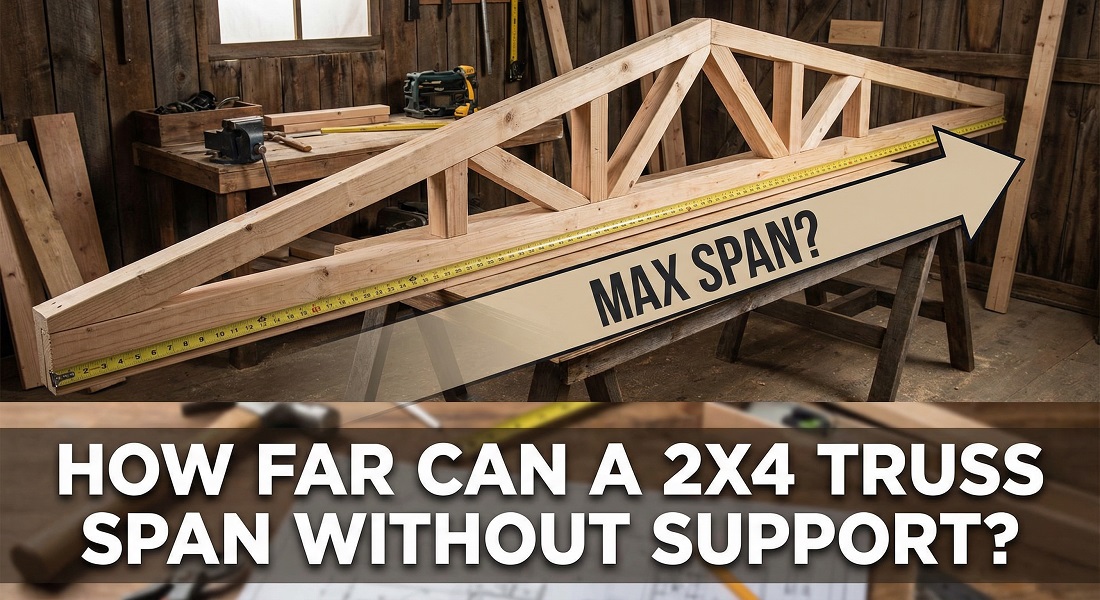
The question itself needs clarification. A single 2×4 board spanning as a beam maxes out at 6-8 feet for floor joists and 8-10 feet for roof rafters depending on load and spacing. An engineered truss system built with 2×4 members can span 20-60+ feet because the triangulated design distributes loads completely differently than a single board.
After 20+ years in construction, I can tell you the confusion between these two concepts causes dangerous mistakes. Let me clear this up with real-world numbers backed by building codes and structural engineering.
Here’s what you actually need to know: You cannot build a safe roof structure by guessing at span limits or using simplified formulas from the internet. Truss design requires engineering calculations that account for dozens of variables. What I can do is help you understand realistic spans, when you need professional engineering, and what actually determines these limits.
Understanding the Difference: Board Span vs. Truss Span
Single 2×4 Board Spanning (Rafter or Joist)
When a single 2×4 spans a distance, it acts as a simple beam carrying the entire load through bending. This is what most DIYers picture when asking about span limits.
Realistic maximum spans for a single 2×4 (per IRC building code):
2×4 ceiling joists (supporting only drywall, minimal attic load):
- 16-inch spacing: 10 feet maximum
- 24-inch spacing: 8 feet maximum
2×4 floor joists (supporting living space):
- Not recommended for floors in modern construction
- Historical use: maximum 6-7 feet at 16-inch spacing
- Code now requires 2×6 minimum for floor joists
2×4 roof rafters (supporting roof load):
- 16-inch spacing: 9-11 feet depending on snow load
- 24-inch spacing: 7-9 feet depending on snow load
- Species and grade matter significantly
These numbers come from the International Residential Code (IRC) span tables that structural engineers and building inspectors use. They’re not estimates or rules of thumb—they’re calculated safe limits based on structural engineering and decades of building performance data.
The key point: A single 2×4 board maxes out around 8-11 feet depending on use and spacing. Anyone telling you a 2×4 can span 35 feet is talking about something completely different—engineered trusses.
Engineered Truss Systems Using 2×4 Members
An engineered truss is a structural framework where individual 2×4 members are connected in triangular patterns. The genius of truss design is that it converts bending forces (which wood handles poorly) into tension and compression forces (which wood handles well).
Realistic truss spans using 2×4 members:
Light residential roof trusses (typical suburban house):
- Common span: 24-32 feet
- Maximum practical span: 40-50 feet with proper engineering
- Spacing: typically 24 inches on center
Agricultural or shop building trusses (lower roof loads):
- Common span: 30-50 feet
- Can reach 60+ feet with engineered designs
- Larger member sizes (2×6, 2×8) used for longer spans
Commercial truss systems:
- Often use larger members (2×6 minimum) for spans over 40 feet
- Engineered specifically for load requirements
- 60-80+ foot spans possible with proper design
Here’s the reality check: Every truss spanning over 24 feet should be professionally engineered with stamped plans. Most truss manufacturers won’t fabricate trusses without engineer-stamped drawings. And building departments won’t permit them without engineering approval.
The “how far can it span” question doesn’t have a simple answer because it depends on truss configuration, load requirements, member grade, connection methods, and bracing—all of which require engineering calculations.
What Actually Determines Truss Span Limits
Load Requirements (Dead Load + Live Load)
Dead load is the permanent weight the truss carries: roofing material, sheathing, insulation, drywall ceiling, and the truss itself.
Typical residential roof dead loads run 10-15 pounds per square foot. Asphalt shingles add about 3 pounds per square foot. OSB sheathing adds 2-3 pounds. Drywall ceiling adds 2 pounds. Insulation adds 1-2 pounds. The truss members themselves add weight.
Live load is temporary weight: snow, wind, workers during construction, maintenance access.
Building codes specify minimum live loads based on geography. Snow load areas in the northern states require 30-70+ pounds per square foot. Southern states with no snow might require only 20 pounds per square foot for wind and maintenance access.
Total load determines truss design. A truss spanning 30 feet in Arizona (20 psf live load) looks completely different than a truss spanning 30 feet in Minnesota (50+ psf snow load). The Minnesota truss needs heavier members, closer spacing, or different configuration.
This is why you can’t use a simple formula or generic answer for truss span. The loads vary by location, and truss design must account for your specific code requirements.
Truss Configuration and Web Design
Trusses come in dozens of configurations, and each has different span capabilities:
Fink truss (most common residential): W-shaped web pattern, efficient for 20-36 foot spans
Howe truss: Vertical and diagonal webs, good for 30-50 foot spans
Scissors truss: Creates vaulted ceiling, typically 20-40 foot spans
Attic truss: Provides storage or living space in attic, limited to 24-32 foot spans typically
Parallel chord truss: Flat top and bottom, used for floors or flat roofs, 20-40 foot spans
Each configuration distributes forces differently. A fink truss at 32 feet might be perfectly adequate, while a scissors truss at 32 feet might need 2×6 members instead of 2x4s because the angled bottom chord creates different force requirements.
Professional truss designers select configuration based on:
- Required span
- Roof pitch
- Load requirements
- Ceiling requirements (flat vs. vaulted)
- Building width and architectural needs
You don’t choose configuration based on what you think might work—you select it based on engineering analysis of the specific application.
Lumber Grade and Species
Not all 2x4s are equal. Lumber comes in different species and grades that dramatically affect strength.
Common species used for trusses:
Douglas Fir-Larch: Strong, commonly used, widely available. Fiber stress in bending: 1,000-1,500 psi depending on grade.
Spruce-Pine-Fir (SPF): Most common for residential trusses. Lighter, less expensive. Fiber stress: 875-1,400 psi depending on grade.
Southern Yellow Pine: Strong and dense, common in southeastern US. Fiber stress: 1,000-1,600 psi depending on grade.
Hem-Fir: West Coast species, moderate strength. Fiber stress: 850-1,350 psi depending on grade.
Grades matter as much as species:
Select Structural: Highest grade, fewest defects, maximum strength
#1 and #2: Standard construction grades with different allowable defect limits
Stud grade: Adequate for vertical compression but not ideal for truss members
Economy and utility grades: Not suitable for structural trusses
A #2 SPF 2×4 might have 1,000 psi fiber stress rating, while a Select Structural Douglas Fir 2×4 might have 1,500 psi—that’s a 50% strength difference affecting how far the truss can span.
Truss manufacturers specify exact species and grade requirements on engineering drawings. You can’t substitute #2 for #1 grade or SPF for Douglas Fir without re-engineering the truss.
Truss Spacing and Roof Geometry
Truss spacing (how far apart trusses are placed) directly affects how much load each truss carries.
16-inch spacing: Each truss supports 1.33 feet of roof width. More trusses required, higher material cost, but each truss carries less load.
24-inch spacing: Each truss supports 2 feet of roof width. Standard for residential construction. Good balance of cost and performance.
48-inch spacing: Sometimes used for agricultural buildings or metal roofing. Each truss supports 4 feet of roof width, requiring stronger trusses.
Wider spacing means each truss carries more load, requiring stronger design. A truss spanning 30 feet at 24-inch spacing might use 2×4 members. The same 30-foot span at 48-inch spacing might require 2×6 members because each truss carries double the load.
Roof pitch also affects truss design. Steeper pitches create different force distributions in truss members. A 4:12 pitch truss has different internal forces than an 8:12 pitch truss at the same span.
Wind exposure matters too. A truss in open plains with high wind loads needs different engineering than a truss in a sheltered valley with minimal wind.
Connection Methods and Bracing
Truss members must be connected properly for the truss to work as designed. The connections—where individual 2x4s meet—are critical structural points.
Professional trusses use metal connector plates (also called truss plates or gang-nail plates). These galvanized steel plates with punched teeth get pressed into both sides of the connection, creating strong joints that can handle thousands of pounds of force.
A single connector plate might have 200+ teeth embedded into the wood, distributing forces across a large area. This is what allows trusses to span distances that individual boards never could.
Site-built trusses sometimes use gusset plates—plywood or OSB panels fastened with structural screws or bolts. These are weaker than metal truss plates but can work for smaller spans if properly engineered.
Bracing is essential for truss stability. Individual trusses are relatively narrow (3.5 inches wide for 2×4 trusses) and can roll or buckle sideways without proper bracing.
Permanent bracing includes roof sheathing and ceiling drywall. Temporary bracing during construction requires lateral bracing every 8-10 feet along the truss span and diagonal bracing connecting multiple trusses.
Truss failures often result from inadequate bracing during construction, not from span limitations. The truss can support the design load but collapses before sheathing is installed because it wasn’t braced properly.
Why You Can’t Calculate Truss Spans with Simple Formulas
Some websites offer simplified formulas like “multiply PSI by spacing by width and divide by weight.” This is structurally meaningless for truss design.
Real truss engineering involves:
1. Load path analysis: Tracing how forces travel through each member from roof surface to bearing walls
2. Member stress calculations: Determining tension, compression, and shear forces in every single truss member
3. Connection design: Calculating required connector plate sizes and tooth embedment
4. Deflection limits: Ensuring the truss doesn’t sag excessively even if it’s strong enough (L/240 or L/360 deflection limits)
5. Lateral buckling analysis: Preventing compression members from buckling sideways
6. Combined stress analysis: Accounting for multiple force types acting on members simultaneously
Professional engineers use software like MiTek or Alpine truss design programs that perform thousands of calculations per truss, checking every member and connection against building code requirements.
The idea that you can multiply a few numbers together and determine safe truss span is like saying you can design a bridge by measuring how much weight a single steel beam can hold. The structure is far more complex than that.
When Professional Engineering Is Required
Building codes require engineered trusses for most applications. The International Residential Code (IRC) allows prescriptive (non-engineered) roof framing using rafters and ceiling joists with specific span limits, but once you’re building trusses, you’ve moved beyond prescriptive methods.
You need professional engineering and stamped drawings for:
Trusses spanning over 24 feet in residential applications (some jurisdictions require engineering for any truss regardless of span)
Any non-standard truss configuration (scissors, attic, parallel chord, custom designs)
Heavy roof loads (tile, slate, concrete roofing, or high snow loads)
Trusses supporting concentrated loads (HVAC equipment, water tanks, etc.)
Commercial or multi-family buildings (always require engineered trusses)
Any situation where building inspector requests engineered drawings
Most truss manufacturers provide engineering as part of their service. You give them your building dimensions, roof pitch, spacing requirements, and load data, and they engineer trusses specifically for your project. This typically costs $200-800 depending on project complexity, and it’s included in the truss package price.
Attempting to build trusses without engineering is dangerous and illegal in most jurisdictions. If a truss fails and someone is injured or killed, you face criminal liability for building an unpermitted, non-code-compliant structure.
Realistic Span Expectations for Common Situations
Let me give you real-world examples based on actual truss projects I’ve worked on:
24-foot garage or small house (4:12 pitch, 24-inch spacing, 30 psf snow load, asphalt shingles): Standard fink truss using 2×4 SPF #2 top and bottom chords, 2×4 webs, metal connector plates. This is routine residential construction requiring no special design considerations.
32-foot ranch house (5:12 pitch, 24-inch spacing, 40 psf snow load, asphalt shingles): Fink or double fink truss using 2×4 members works fine with proper engineering. Very common residential application.
40-foot pole barn (3:12 pitch, 48-inch spacing, 25 psf snow load, metal roofing): Parallel chord or Howe truss configuration. Might use 2×4 members but more commonly 2×6 bottom chord due to wider spacing and ceiling load if finished interior planned.
50-foot shop building (4:12 pitch, 24-inch spacing, 30 psf snow load, metal roofing): Definitely requires engineered design. Might use 2×6 top and bottom chords with 2×4 webs, or all 2×6 members depending on specific loads. Metal connector plates essential.
60+ foot spans: At this distance, you’re typically looking at commercial applications with 2×6 or larger members, specialized truss configurations, and possibly steel reinforcement. Pure 2×4 construction becomes impractical.
The pattern you should see: As span increases, complexity increases. Spans up to 32 feet are routine with 2×4 trusses. 32-40 feet requires careful engineering but is achievable. 40-50 feet is pushing 2×4 limits and often requires larger members. Beyond 50 feet, 2×4 construction is rarely used.
Safety Considerations and Building Code Compliance
Building codes exist because structures fail when improperly designed. Roof collapses kill and injure people every year. Most failures result from inadequate engineering, substandard materials, or improper construction methods.
Before building any roof structure, you must:
Check local building codes and permit requirements. Most jurisdictions require permits for any roof construction. The permit process includes plan review where building officials verify your truss design meets code.
Obtain engineer-stamped truss drawings. These become part of your permit application and provide the legal documentation that your structure is safe.
Use lumber that meets or exceeds engineered specifications. If drawings call for #1 SPF, you can’t substitute #2 or a different species without approval.
Follow installation instructions exactly. Truss placement, bracing, fastening, and connection details must match engineering drawings.
Install permanent bracing as specified. Roof sheathing, ceiling connections, and any additional bracing called out on drawings are structural requirements, not suggestions.
Have inspections performed at required stages. Most jurisdictions inspect after truss installation before sheathing to verify proper installation and bracing.
Cutting or modifying trusses voids engineering and creates hazards. Homeowners sometimes cut truss members to add attic access or run ductwork. This can cause catastrophic failure. Any modification requires engineering approval.
My Professional Recommendation
If you’re asking how far a 2×4 truss can span, you’re probably asking the wrong question. The real questions should be:
What span do I need for my building? What loads will the roof carry based on my location and roofing material? What truss configuration makes sense for my application? Who can provide properly engineered trusses for my project?
For any roof spanning over 16 feet, contact a professional truss manufacturer. They’ll engineer trusses specifically for your needs, fabricate them with proper connections, deliver them to your site, and provide installation instructions. The cost difference between site-built and manufactured trusses is minimal, and the quality and safety difference is enormous.
For simple sheds or small structures under 16 feet, you might use conventional rafter framing instead of trusses. The IRC provides span tables for 2×4, 2×6, and larger rafters that allow prescriptive (non-engineered) construction for small buildings.
Never guess at structural design. The consequences of failure are too severe. Spend $300-500 on professional engineering rather than risk collapse, injury, code violations, and liability.
Quick FAQ
Can a 2×4 truss really span 40 feet?
An engineered truss system using 2×4 members can span 40 feet with proper design, but not every 40-foot span is suitable for 2×4 construction. Load requirements, spacing, and configuration determine whether 2x4s are adequate. Many 40-foot trusses use 2×6 members for added strength.
What’s the maximum span for 2×4 roof rafters (not trusses)?
Single 2×4 rafters max out around 9-11 feet at 16-inch spacing depending on snow load and lumber grade. Beyond this, you need 2×6 or larger rafters or you need to use engineered trusses instead.
Do I need an engineer for a 24-foot truss?
Most building departments require engineered drawings for any truss construction. Even if your jurisdiction doesn’t require it, professional engineering costs $200-400 and ensures your structure is safe and code-compliant.
Can I build my own trusses to save money?
You can build site-fabricated trusses if you have engineer-stamped plans, proper materials, and the right connection hardware. Most people save money by buying manufactured trusses because the engineering is included and fabrication is faster and more precise than site building.
What spacing should I use for 2×4 trusses?
24-inch spacing is standard for residential construction. Closer spacing (16 inches) allows weaker trusses but requires more materials. Wider spacing (48 inches) requires stronger trusses. The engineer determines appropriate spacing based on loads and span.
How do I know what lumber grade to use?
The engineer specifies lumber grade based on structural requirements. Typical trusses use #1 or #2 grade SPF or Douglas Fir. You cannot substitute lower grades or different species without re-engineering.
There’s no simple answer to “how far can a 2×4 truss span” because truss performance depends on dozens of variables that require engineering analysis. Anyone giving you a specific number without knowing your loads, spacing, configuration, and lumber grade is guessing—and guessing on structural design is dangerous.
What I can tell you after 20+ years:
Engineered trusses using 2×4 members commonly span 24-40 feet in residential construction. Beyond 40 feet, 2×6 or larger members are usually required. Single 2×4 boards (rafters) max out around 9-11 feet regardless of configuration.
Every truss spanning over 24 feet should have professional engineering. Most truss manufacturers include engineering in their pricing, making professional design affordable and accessible.
Building codes require engineered trusses for good reason—improper design kills people. Don’t gamble with structural safety to save a few hundred dollars on engineering.
If you need a roof, call a truss manufacturer. They’ll ask about your building dimensions, roof pitch, local snow loads, and roofing material, then engineer trusses specifically for your needs. You’ll get stamped drawings for your permit, professionally fabricated trusses, and a safe structure that meets code.
The right question isn’t “how far can it span”—it’s “what do I need for my specific building?” Answer that question with professional help, and you’ll get a safe, code-compliant roof that lasts for decades.