
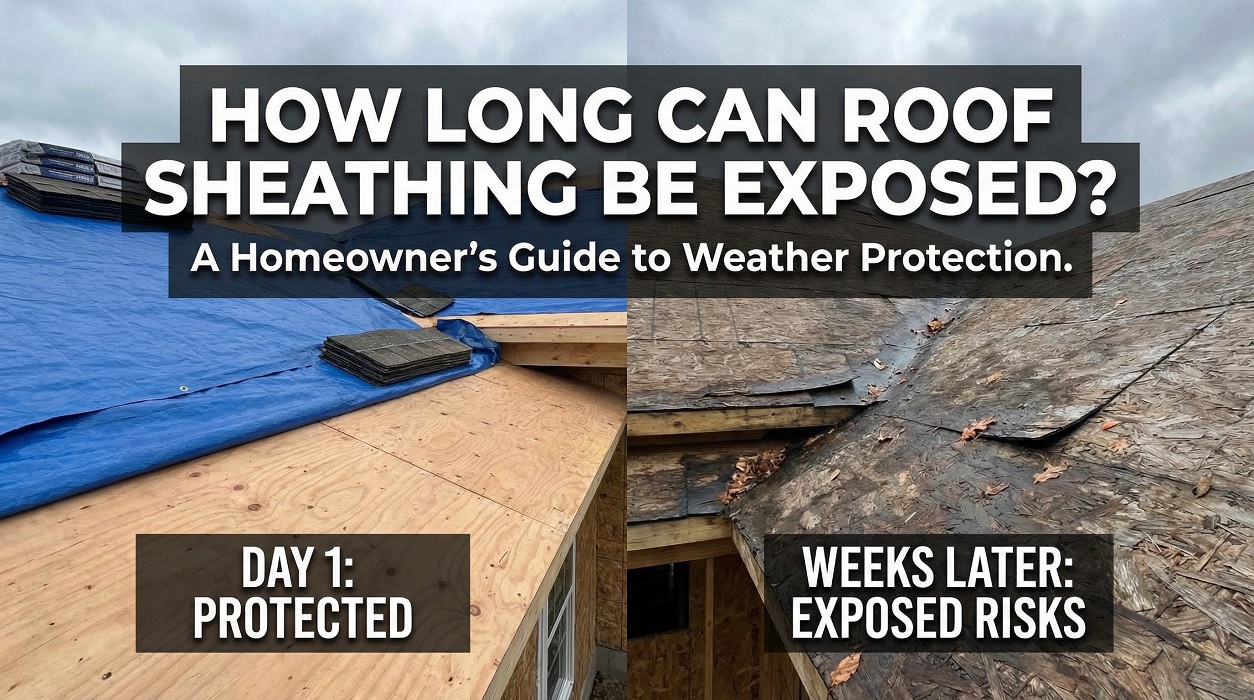
Most roof sheathing should not be exposed longer than 30-60 days maximum. Building codes and manufacturer specifications typically limit exposure to 30 days, with some products rated for extended exposure up to 180 days under specific conditions.
The actual safe exposure period depends on sheathing type, manufacturer ratings, weather-resistive barrier presence, and climate conditions. Exceeding manufacturer exposure limits voids warranties and violates most building codes.
After reviewing manufacturer specifications, APA ratings, and building code requirements, here’s what the research shows about actual exposure limits.
Manufacturer Exposure Ratings (2025 Current Standards)
Sheathing manufacturers publish specific exposure ratings based on testing. These aren’t estimates—they’re engineered limits that affect product warranties and code compliance.
OSB (Oriented Strand Board) roof sheathing: Standard OSB roof sheathing carries 30-day exposure rating per APA standards. Some manufacturers produce extended-exposure OSB rated for 60-90 days with water-resistant coatings or edge sealing.
Products like LP Legacy Premium Sub-Flooring (when used for roof) have 200-day exposure rating due to treated surfaces. Huber AdvanTech sheathing carries 500-day exposure rating with sealed edges and treated surfaces. These premium products cost 30-50% more than standard OSB but provide documented extended exposure capability.
Plywood roof sheathing: Standard CDX plywood (common for roof sheathing) has 30-60 day exposure rating depending on grade and manufacturer. Exposure 1 rated plywood (standard for roofing) can handle brief moisture exposure but isn’t designed for prolonged weather exposure without covering.
RTD (Resistance to Delamination) plywood and marine-grade plywood can withstand longer exposure (90-120 days) but are rarely used for residential roofing due to cost. The key distinction: “Exposure 1” rating means the glue can handle moisture during construction, not that the panel should remain uncovered indefinitely.
The critical issue with exposure ratings: These represent time until performance degradation begins, not total failure time. At 30 days, standard OSB starts swelling at edges, loses fastener holding power, and may develop surface checking. By 60-90 days, structural properties degrade measurably.
Building Code Requirements
International Residential Code (IRC) Section R905 addresses roof covering requirements but doesn’t specify exact sheathing exposure timeframes. However, IRC Section R903.2 requires roof covering installation to proceed in a manner that prevents water intrusion, implying minimal sheathing exposure.
Most local jurisdictions interpret this as requiring sheathing coverage within 30 days or before the next inspection phase. Building inspectors routinely fail framing inspections when sheathing shows water damage, edge swelling, or delamination from extended exposure.
The practical code reality: Your building permit requires continuous progress. Sheathing left exposed for 60+ days signals stalled construction, which can trigger permit expiration proceedings in many jurisdictions. Some municipalities explicitly require sheathing coverage within 30 days or mandate weather protection during construction delays.
Inspection sequencing matters. Most jurisdictions inspect framing before allowing sheathing coverage. If weather delays prevent roofing installation after sheathing goes on, you must demonstrate active weather protection measures to maintain permit validity.
What Actually Happens During Exposure
Research from APA – The Engineered Wood Association and field studies document specific degradation patterns during sheathing exposure.
Days 1-30: Standard OSB and plywood perform adequately if weather is moderate. Light rain causes temporary surface swelling that often recovers when dried. The wood fibers absorb moisture but haven’t reached saturation thresholds that cause permanent damage.
UV exposure during this period causes minimal degradation. Surface darkening occurs but structural properties remain largely intact. This is the window manufacturer exposure ratings target—brief construction exposure before roofing installation.
Days 30-60: Edge swelling becomes pronounced in OSB, particularly at panel joints and cut edges. Research shows OSB thickness can increase 10-20% at edges after repeated wetting/drying cycles in this timeframe. Plywood handles this period better due to cross-laminated construction, but surface checking and minor delamination can begin.
Fastener zones show weakening. Nail holding power can decrease 15-25% in wet OSB compared to dry installation. This matters for shingle attachment and structural connection performance.
Days 60-90: Permanent degradation is measurable. OSB edge swelling often doesn’t fully recover even after drying. Surface deterioration, checking, and potential delamination occur in both OSB and plywood. Fasteners in affected areas may have compromised holding power.
Field studies from university building research centers show structural panel stiffness can decrease 10-15% after 90 days of weather exposure compared to covered panels. This doesn’t mean immediate failure, but it represents measurable property degradation.
Days 90-180: Standard products show significant degradation. OSB not rated for extended exposure experiences severe edge swelling, surface deterioration, and potential delamination. Plywood fares better but still shows checking, grain raising, and glue line exposure. Mold and fungal staining appear on panels, particularly in humid climates.
Research indicates that panels exposed beyond 90 days often require replacement to meet code and warranty requirements, even if they appear structurally intact.
Beyond 180 days: Even extended-exposure rated products reach their limits. Standard products exposed this long should be evaluated by engineers before covering. Moisture content, fastener holding capacity, and structural properties require testing to verify acceptability.
Climate Impact on Exposure Duration
Building science research shows climate zone dramatically affects safe sheathing exposure duration.
Pacific Northwest (marine climate, high rainfall): Standard OSB and plywood shouldn’t exceed 15-20 days exposure during rainy season. Constant moisture cycling causes rapid edge swelling and surface degradation. Extended-exposure rated products are essential if roofing delays are anticipated.
Field research from University of Washington and Oregon State building programs documents OSB edge swelling of 15%+ within 30 days during wet season exposure. Recommendation: Use extended-exposure products or plan construction to minimize exposure.
Southeast (hot-humid climate): High humidity and frequent storms limit standard sheathing to 30-45 days maximum. The combination of moisture and heat accelerates fungal growth and degradation. Research from University of Florida building programs shows mold colonization begins within 48-72 hours on damp sheathing surfaces.
Southwest (hot-arid climate): UV radiation becomes the primary concern rather than moisture. Standard sheathing can handle 60-90 days from moisture perspective, but UV exposure causes surface checking and fiber degradation. Temperature extremes (140°F+ surface temps) cause panel warping and adhesive degradation in OSB.
Northern climates (cold, freeze-thaw cycles): Moisture absorption followed by freezing causes mechanical damage to wood fibers. Freeze-thaw cycling significantly accelerates degradation. Standard products shouldn’t exceed 30-45 days when freeze-thaw cycles occur.
Research from University of Minnesota Cold Climate Housing Program shows each freeze-thaw cycle in saturated panels causes micro-cracking that accumulates over multiple cycles, reducing long-term performance even after panels dry.
The climate pattern: Wet and humid climates require shortest exposure duration or extended-exposure products. Dry climates allow longer exposure but UV protection becomes important.
Weather-Resistive Barriers (Critical Factor Often Overlooked)
Synthetic underlayment or felt paper installed over sheathing dramatically extends safe exposure duration. This is the factor many discussions of sheathing exposure miss entirely.
Standard 30-lb felt paper provides 2-4 weeks additional protection over bare sheathing. The felt absorbs and sheds water, preventing direct sheathing saturation. However, felt itself degrades with UV exposure (30-60 days until breakdown) and isn’t a long-term solution.
Synthetic underlayment (Tyvek, Grace, Titanium, etc.) rated for 90-180 days UV exposure provides substantial sheathing protection during construction delays. Research shows sheathing under synthetic underlayment experiences 60-80% less moisture cycling compared to bare sheathing.
The practical reality: If your sheathing will be exposed beyond 30 days, installing synthetic underlayment immediately after sheathing installation is critical. This costs $300-800 for typical residential roof but prevents thousands in sheathing replacement and water damage.
Building codes in high-wind coastal areas often require underlayment installation within 48 hours of sheathing installation specifically to provide weather protection during construction.
Edge Sealing and Protective Treatments
Research from APA and product testing shows edge sealing dramatically improves OSB moisture resistance. Unsealed OSB edges absorb moisture 5-10x faster than face surfaces due to exposed strand ends.
Field-applied edge sealers (products like Huber Edge Seal or Liquid Edge Gold) reduce edge moisture absorption by 70-90% per manufacturer testing. Application adds $0.10-0.25 per linear foot but extends safe exposure duration by 50-100% in wet conditions.
Factory edge-sealed products (AdvanTech, LP Legacy, etc.) incorporate edge treatment during manufacturing with superior performance to field application. These products form the basis of extended-exposure ratings (200-500 days).
Surface treatments and coatings: Some installers apply water-repellent coatings to sheathing before covering. While this provides some protection, it’s not a substitute for proper roofing installation or rated extended-exposure products. Coatings aren’t tested or warranted for extended sheathing exposure in most cases.
Warranty and Liability Implications
Manufacturer warranties require installation per specifications, which includes exposure duration limits. Exceeding rated exposure typically voids material warranties.
For standard OSB or plywood exposed beyond 30-60 days showing visible degradation (edge swelling, delamination, surface checking), manufacturers can deny warranty claims for future performance issues including nail pops, fastener failure, or structural deficiency.
Liability considerations: If sheathing-related failure occurs (roof structural issue, water intrusion due to fastener pull-out, etc.) and investigation reveals the sheathing was exposed beyond manufacturer limits during construction, liability may fall on the builder rather than material manufacturer.
Insurance claims for construction defects can be denied if sheathing exposure exceeded standards. Documentation matters: Builders should photograph sheathing condition and installation dates to document compliance with exposure limits.
When Sheathing Must Be Replaced
Field assessment after extended exposure should evaluate:
Edge swelling: If OSB edges are swollen 1/8″ or more and don’t return to flush when dried, replacement is typically required. Swollen edges create uneven roof surface, telegraph through shingles, and compromise fastener holding.
Delamination: Any visible separation of plywood veneers or OSB strand layers indicates failure requiring replacement. This typically appears as edge lifting or surface bubbling.
Surface deterioration: Severe checking, grain raising, or surface fiber loss indicates UV and moisture damage reducing fastener holding capacity and structural properties.
Mold or fungal growth: Surface mold can often be cleaned, but mold penetration into panel interior (visible at edges or through surface) indicates moisture saturation requiring replacement.
Fastener zone integrity: If test fasteners (nails or screws) don’t achieve firm holding or pull out easily, the panel has lost structural integrity.
The replacement decision threshold: If sheathing shows any of these conditions after extended exposure, replacement is almost always more cost-effective than risking future failure. Replacement costs $2-4 per square foot installed. Future roof failure repair costs run $5,000-25,000+.
Protection During Construction Delays
When construction delays extend beyond planned schedules, active sheathing protection is essential.
Immediate coverage with synthetic underlayment provides 90-180 days additional protection for minimal cost. This should be installed within 30 days of sheathing installation if roofing delays are anticipated.
Temporary tarping can protect exposed areas during multi-week delays, but tarps must be properly secured and monitored. Wind-damaged tarps cause more harm than no covering by trapping moisture and creating mechanical damage from flapping.
Ventilation under temporary coverings prevents moisture accumulation. Tarps sealed tightly can trap condensation, creating worse conditions than exposure. Leave edges open or use breathable coverings.
Regular inspection during exposure period allows early identification of degradation. Check edges for swelling, surfaces for checking or delamination, and fastener zones for integrity every 2-4 weeks during extended exposure.
The key principle: If you know roofing installation will be delayed beyond 30 days, don’t leave sheathing bare. Install underlayment immediately to preserve sheathing integrity and maintain warranty coverage.
Product-Specific Recommendations
Based on manufacturer specifications and field performance data:
Standard construction, normal schedule (roofing within 30 days): Standard OSB or CDX plywood (Exposure 1 rated) is adequate and cost-effective. Follow manufacturer installation specs and cover within exposure rating.
Wet climates or potential delays: Extended-exposure OSB (Huber AdvanTech, LP Legacy, ZIP System) or RTD plywood justified by reduced replacement risk and extended protection. Premium cost ($0.40-0.80/sq ft additional) is insurance against weather delays.
Coastal high-wind areas: Building codes often mandate specific products. Follow code requirements which typically specify extended-exposure ratings and rapid underlayment installation.
Budget-constrained projects in moderate climates: Standard products with immediate synthetic underlayment installation provides good protection at reasonable cost. Underlayment costs less than extended-exposure sheathing upgrade.
Projects with known timeline issues (permitting delays, material availability, labor scheduling): Invest in extended-exposure products upfront. The premium cost is less than potential replacement and schedule disruption from degraded standard products.
Summary
Roof sheathing exposure duration depends on product type, manufacturer ratings, climate conditions, and weather protection measures. Standard OSB and plywood should not exceed 30 days bare exposure. Extended-exposure products can handle 60-180 days when conditions and product ratings align.
Critical factors: Manufacturer exposure ratings determine warranty coverage. Building codes generally require coverage within 30 days. Climate significantly impacts degradation rate. Weather-resistive barriers dramatically extend safe exposure duration.
Best practice: Install synthetic underlayment within 30 days of sheathing installation if roofing delays are anticipated. This protects sheathing, maintains warranties, and complies with most code requirements for weather protection.
When extended exposure has occurred: Inspect for edge swelling, delamination, surface deterioration, and fastener holding capacity. Replace compromised panels rather than risking future roof system failure.
Key References:
- APA – The Engineered Wood Association performance standards and exposure ratings
- IRC Section R905 (roof covering requirements)
- Manufacturer technical specifications (Huber, LP, Georgia-Pacific, Weyerhaeuser)
- University building research programs (U of MN, U of FL, Oregon State, U of WA)