
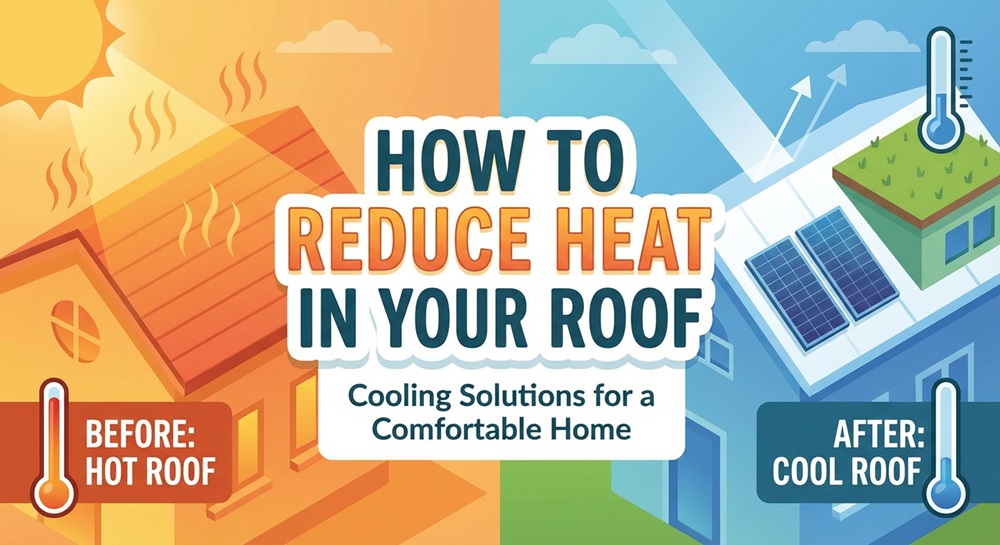
The reality of roof heat reduction: It’s a combination of smart material choices during construction and practical interventions you can implement on existing roofs. Understanding both approaches gives you options regardless of whether you’re building new or cooling down an existing home.
Cool Roof Rating Council data shows that proper heat reduction strategies can lower roof surface temperatures by 50-60°F and cut cooling costs by 15-30%. Here’s what actually works based on current building science research and field-tested solutions.
Why Roofs Trap Heat (The Science Behind It)
Before implementing solutions, understanding how heat enters your home through the roof helps you choose the right intervention.
How Roofing Materials Absorb Heat
Solar reflectance determines how much heat your roof absorbs. Dark-colored asphalt shingles absorb 85-95% of solar radiation, reaching surface temperatures of 150-170°F on a 90°F day. Light-colored or reflective materials absorb only 20-40%, staying 40-60°F cooler under identical conditions.
Material composition matters beyond color. Some materials (metal, tile) re-emit absorbed heat quickly through thermal emittance. Others (dark asphalt) retain heat and transfer it into the attic space below.
Current research from Lawrence Berkeley National Laboratory shows roofing material choice alone accounts for 25-35% of a home’s cooling load in hot climates.
How Roof Design Affects Heat Transfer
Inadequate ventilation traps hot air in attic spaces. Sealed attics can reach 140-160°F in summer, radiating heat downward through ceiling insulation into living spaces. Properly ventilated attics stay within 10-15°F of outdoor temperature.
Insufficient insulation allows heat transfer through conduction. Even with cooler attic temperatures, inadequate insulation (below current R-49 to R-60 recommendations) allows heat to penetrate into conditioned spaces.
Thermal bridging through rafters, joists, and penetrations creates pathways for heat to bypass insulation, accounting for 15-25% of total heat gain in some roof assemblies.
Consequences of Excessive Roof Heat
Indoor comfort and health impacts:
- Indoor temperatures can exceed 85-90°F without adequate cooling
- Increased risk of heat-related illness for vulnerable populations
- Higher humidity levels as AC systems struggle to keep up
- Elevated energy costs (10-40% higher cooling bills)
Roof material degradation:
- Accelerated aging of asphalt shingles (10-15% lifespan reduction per 10°F average temperature increase)
- Thermal expansion stress causing cracks, curling, and seal failures
- UV degradation compounds with high temperatures
- Premature failure of underlayment and flashings
Preventive Solutions (New Construction or Re-Roofing)
These decisions during installation establish baseline thermal performance for the roof’s entire lifespan.
Choose Cool Roofing Materials
Reflective asphalt shingles (ENERGY STAR certified):
Products like Owens Corning Duration Cool, GAF Timberline Cool Series, and CertainTeed Landmark Solaris reflect 25-40% of solar radiation compared to 5-15% for standard dark shingles.
Temperature reduction: 20-30°F cooler surface than standard asphalt
Cost: $15-30 additional per square (100 sq ft) over standard shingles
Lifespan: 25-30 years
Metal roofing with reflective finish:
Factory-painted metal with cool pigments reflects 60-70% of solar radiation. Standing seam and corrugated profiles allow thermal movement without stress damage.
Temperature reduction: 40-50°F cooler than dark asphalt
Cost: $400-800 per square installed
Lifespan: 40-70 years
Clay and concrete tile:
Natural thermal mass delays heat transfer 2-4 hours, shifting peak heat load to evening when outdoor temperatures drop. Light-colored or glazed tiles reflect 40-70% of solar radiation.
Temperature reduction: 30-50°F cooler than dark asphalt
Cost: $600-1,200 per square installed
Lifespan: 50-100 years
Weight consideration: Requires adequate structural support (9-12 lbs per sq ft versus 2-3 for asphalt)
Slate roofing:
Natural stone with inherent reflective properties and excellent thermal stability. Premium option justified by extreme longevity.
Temperature reduction: 20-40°F cooler than dark asphalt (varies by color)
Cost: $1,200-2,500 per square installed
Lifespan: 75-150 years
Optimize Attic Ventilation
Balanced intake and exhaust ventilation maintains attic temperatures within 10-15°F of outdoor air temperature versus 50-60°F above outdoor temp in unventilated attics.
Building code minimum: 1 square foot net free ventilation area per 150 square feet of attic floor space
Best practice: 1 square foot per 100 square feet for improved performance
Effective ventilation components:
Ridge vents: Continuous along entire roof peak provides maximum exhaust capacity. Cost: $3-8 per linear foot installed.
Soffit vents: Continuous perforated soffit or individual vents every 3-4 feet provides intake air. Cost: $2-5 per linear foot installed.
Powered attic fans: Solar-powered units ($300-600 installed) or thermostat-controlled electric fans ($200-400 installed) supplement passive ventilation, reducing attic temperature an additional 10-15°F.
Install Adequate Attic Insulation
Current Department of Energy recommendations by climate zone:
Hot climates (Zone 1-3): R-38 to R-60
Mixed climates (Zone 4-5): R-49 to R-60
Cold climates (Zone 6-8): R-60
Insulation options:
Blown fiberglass or cellulose: Cost-effective at $1.00-2.50 per square foot installed. Achieves R-49 to R-60 with 15-20 inch depth.
Spray foam (closed-cell): Superior air sealing plus highest R-value per inch (R-6 to R-7). Cost: $2.50-4.50 per square foot installed.
Radiant barrier: Reflective foil installed under roof deck reflects 95% of radiant heat back toward roof. Cost: $0.15-0.40 per square foot. Most effective when combined with ventilation.
Air sealing before insulation: Sealing gaps around penetrations, top plates, and attic access improves insulation effectiveness 15-30%.
Strategic Landscaping
Shade trees reduce roof surface temperature 20-45°F according to University of Florida research.
Effective tree placement:
Plant deciduous trees 15-25 feet from house on south and west sides. These provide summer shade while allowing winter sun after leaf drop.
Fast-growing shade trees: Red Maple (40-60 ft, 2-3 ft/year growth), Hybrid Poplar (40-50 ft, 5-8 ft/year), Live Oak (40-80 ft, evergreen for year-round shade in southern climates).
Timeline: 10-20 years for trees to reach roof-shading height.
Immediate shade options: Pergolas or shade structures ($1,500-8,000) provide 15-30°F roof temperature reduction in shaded areas while trees mature.
Retrofit Solutions (Existing Roofs)

These interventions can be implemented on roofs already installed without full replacement.
Apply Reflective Roof Coating
Most cost-effective retrofit option with 3-7 year payback period.
White elastomeric coatings:
Solar reflectance: 80-90%
Temperature reduction: 40-50°F versus uncoated dark surfaces
Cost: $0.75-1.50 per square foot installed
Lifespan: 5-10 years before recoating
Products: Sherwin-Williams SuperDeck, Henry 287 Tropicool, Rust-Oleum Reflective Roof Coating
Application process: Clean roof thoroughly, repair damage, apply two coats (20-30 mils total wet thickness). Requires dry weather and temperatures above 50°F.
Colored cool coatings: 2025 formulations offer tan, gray, and terracotta options with 50-70% solar reflectance—significantly better than traditional dark colors while providing aesthetic variety.
Cooling cost savings: 10-20% reduction in hot climates per Department of Energy studies.
Install Solar Panels
Dual benefit—shading plus energy generation.
UC San Diego research documents 38°F average roof temperature reduction under panel-covered areas. Panels installed 4-8 inches above roof surface create shade while allowing airflow underneath.
Energy offset: Typical 6-8 kW residential system generates enough power to offset 60-100% of cooling electricity in many climates.
2025 system costs:
- Installation: $2.50-3.50 per watt ($15,000-28,000 for 6-8 kW before incentives)
- Federal tax credit: 30% through 2032
- Net cost: $10,500-19,600 after federal credit
- Payback period: 6-12 years depending on electricity rates
Create a Green Roof
Living roof systems provide 30-40°F surface temperature reduction according to Portland State University research.
Extensive green roof (lightweight):
Growing medium: 2-6 inches deep
Plant types: Sedums, succulents, native grasses
Weight: 15-35 lbs per square foot (saturated)
Cost: $10-25 per square foot installed
Maintenance: 1-2 visits annually
Most residential structures can support without reinforcement.
Additional benefits: Absorbs 40-80% of rainfall, extends roof membrane life by reducing UV and thermal cycling, improves air quality, reduces urban heat island effect.
Limitations: Higher upfront cost, requires waterproofing integrity verification, ongoing maintenance for plant health.
Add Insulation Layers
Insulator membrane options for existing roofs:
Radiant barrier (reflective foil):
Installs on underside of roof rafters or over existing insulation. Reflects 95% of radiant heat. Cost: $300-1,000 for average attic DIY, $800-2,000 professional installation.
Rigid foam board (above existing insulation):
Polyiso (R-6 per inch), XPS (R-5 per inch), or EPS (R-4 per inch). Adds R-12 to R-24 with 2-4 inch thickness. Cost: $1.50-3.50 per square foot installed.
Spray foam (attic floor or roof deck):
Closed-cell spray foam provides insulation plus air sealing. Cost: $2.00-4.00 per square foot for 3-4 inch application.
Most effective combination: Radiant barrier plus adequate loose-fill insulation to meet R-49 to R-60 recommendations.
Install Roof Misting System
Evaporative cooling for dry climates only.
Automated systems spray fine water mist onto roof surface at timed intervals. Water evaporation removes heat from roof surface.
Temperature reduction: 25-35°F during operation
System cost: $800-2,500 installed for average residential roof
Operating cost: 10-30 gallons per hour during operation, approximately $20-50 monthly water cost
Effectiveness limitation: Only works in low-humidity climates (below 50-60% relative humidity). Not effective in humid regions where evaporative cooling fails.
Best applications: Desert Southwest, inland California, areas with dry summer climates.
Cost-Benefit Comparison
Solutions ranked by return on investment for typical 1,500 sq ft home in hot climate:
| Solution | Upfront Cost | Annual Savings | Payback |
|---|---|---|---|
| Cool roof coating | $1,200-2,250 | $180-350 | 4-7 years |
| Attic insulation upgrade | $1,500-3,500 | $200-400 | 4-9 years |
| Radiant barrier | $300-800 | $80-150 | 3-6 years |
| Solar panels | $10,500-19,600 | $1,200-2,000 | 6-12 years |
| Reflective shingles (at re-roof) | +$500-1,000 vs standard | $200-400 | 2-4 years |
| Green roof | $15,000-37,500 | $150-350 | 40+ years |
Notes: Savings vary by climate, electricity rates, existing conditions, and home characteristics. Solar panel economics include federal tax credit.
Regional Recommendations
Hot-Dry Climates (Southwest):
Priority: Cool roof coatings or reflective materials (extreme sun exposure makes this highest-impact intervention)
Secondary: Roof misting systems (low humidity enables evaporative cooling)
Insulation: R-49+ recommended
Hot-Humid Climates (Southeast, Gulf Coast):
Priority: Reflective roofing plus attic ventilation (manage heat and moisture together)
Secondary: Radiant barrier (reduces radiant heat load to attic)
Caution: Roof misting ineffective due to high humidity
Mixed Climates (Mid-Atlantic, Midwest):
Priority: Attic insulation upgrade (year-round benefit for heating and cooling)
Secondary: Cool roof coating or reflective shingles at re-roof
Tree placement: Deciduous on south/west for summer shade, winter sun
Frequently Asked Questions
How much can I reduce my cooling costs with a cool roof?
Research shows 10-30% cooling cost reduction depending on climate, existing conditions, and home characteristics. Hottest climates see highest savings.
Does roof color really make that much difference?
Yes. White or light-colored roofs stay 40-60°F cooler than dark roofs under identical conditions. This translates to 10-20°F lower attic temperatures and measurably reduced cooling loads.
Can I apply reflective coating to any roof type?
Most roof types accept reflective coatings, but application requirements vary. Asphalt shingles, metal, and flat roofs are most common. Check product compatibility and warranty implications before application.
How long does reflective roof coating last?
Quality elastomeric coatings last 5-10 years before recoating is needed. Silicone coatings last 10-15 years. Lifespan depends on climate exposure and coating thickness.
Is attic insulation or roof coating more important?
Both matter, but insulation typically provides higher ROI because it reduces heat transfer year-round (cooling and heating savings). Start with insulation if below current R-49 to R-60 recommendations, then add reflective coating for additional cooling benefit.
Do solar panels actually cool the roof?
Yes. Research documents 30-40°F temperature reduction under panel-covered areas because panels shade the roof while allowing airflow underneath. This is a secondary benefit beyond energy generation.
Bottom Line
Start with the basics—proper insulation and ventilation—before investing in advanced solutions. These deliver year-round energy savings with the fastest payback.
Add cool roof coatings or reflective materials when your roof needs attention anyway. The incremental cost is small, but the cooling benefit is significant.
For maximum impact, combine strategies: reflective roofing plus R-60 insulation plus balanced ventilation can cut roof-related cooling loads by 50-70%.
Your roof doesn’t have to be a heat magnet. With the right approach, it can actually help keep your home comfortable without running your AC constantly.