
Roof valleys naturally divert water when properly installed—the problem is when they’re installed wrong or maintained poorly. As a Roofing Professionals, I’ve fixed hundreds of valley failures. The issue is almost never “how to divert water” from a valley—it’s fixing installation mistakes, clearing debris, or repairing damaged flashing that’s preventing the valley from doing its job.
A properly installed valley with the right flashing and pitch will handle massive water flow without any special tricks. When water isn’t flowing correctly, you’ve got one of three problems: bad installation, debris blocking flow, or damaged materials.
Let me show you how to identify which one you’ve got and fix it.
Diagnosing Your Valley Problem What’s Wrong?
Before you start “fixing” your valley, figure out what’s actually broken. Grab a ladder, get on the roof (safely—if you’re not comfortable up there, hire someone), and look at the valley.
Visual Inspection Checklist
Is there debris in the valley? Leaves, pine needles, shingle granules, moss, dirt—anything that could block or slow water flow?
If yes, that’s your problem. Not the valley design. Not the pitch. Not the flashing. Clean it out and see if your drainage issues disappear.
Is water staining visible on shingles adjacent to the valley? Dark streaks, algae growth, or discoloration running parallel to the valley on the roof surface?
If yes, water is backing up under shingles because something is blocking flow or the valley has a low spot where water pools instead of draining.
Is the valley metal visible (open valley) or covered by shingles (closed valley)?
Open valleys are easier to maintain and diagnose. You can see exactly what’s happening. Closed valleys hide problems until you’ve got an interior leak.
Can you see any low spots, sags, or areas where the valley isn’t following a straight line from ridge to eave?
If yes, you’ve got a structural issue—valley rafters have sagged or were undersized. This requires framing repair, not just flashing replacement.
Is the metal flashing corroded, rusted, or showing holes?
If yes, flashing has reached end of life and needs replacement. Aluminum lasts 25-40 years, galvanized steel 15-30 years. If your roof is approaching these ages, flashing failure is normal wear-out.
In winter, does ice build up in the valley and create dams?
If yes, you’ve got an ice dam problem, which is really a heat loss and insulation problem, not a valley design problem.
The Hose Test
After visual inspection, run water through the valley with a garden hose at the ridge end. Watch what happens.
Water flows fast and steady to gutter with no pooling: Valley is working correctly. If you’re getting leaks, the issue is underlayment or flashing integrity, not drainage.
Water pools in spots before continuing down: You’ve got debris blocking flow or a pitch problem creating low spots.
Water backs up immediately and runs sideways under shingles: Severe blockage or major pitch issue. Needs immediate attention.
This test tells you whether the valley can actually move water or if something’s preventing it.
When You Actually Need to Divert Valley Water?
Now, there ARE legitimate situations where you need to redirect or split valley water flow. These are the exceptions, not the rule.
Situation 1: Valley Dumps Directly Onto Lower Roof or Structure
The problem: Your valley ends at an eave that’s directly above another roof section, a porch, or covered entry. All that concentrated water hammers one spot on the lower roof, overwhelming that area’s drainage or causing erosion.
Real example: Two-story colonial with main roof valley ending directly over garage roof. During heavy rain, 30+ gallons per minute from the valley hit a 3-foot section of garage roof. Water would pool, back up under garage shingles, and leak into the garage ceiling.
The solution: Install a valley splash guard or diverter at the valley terminus to spread water across a wider area rather than concentrating it in one spot.
Situation 2: Valley Overflows Gutter Capacity
The problem: The gutter at the valley bottom can’t handle the concentrated flow volume. Water overshoots the gutter during heavy rain, dumping behind it or splashing over the front.
Why this happens: Gutters are typically sized for distributed rainfall across roof area. Valleys concentrate flow from large roof sections into one point. Standard 5-inch K-style gutters handle 2,400 square feet of roof area—but that assumes distributed flow, not 40 gallons per minute hitting one 12-inch section of gutter.
The solution: Install oversized gutter section at valley (6-inch or 7-inch), add a second downspout at valley location, or install a flow spreader to distribute valley water across 3-4 feet of gutter rather than dumping at one point.
Situation 3: Valley Creates Concentrated Ice Dam Location
The problem: In cold climates, the valley becomes a chronic ice dam spot where ice builds up and causes repeated leaks every winter despite having heat cable and adequate insulation.
Why this is different: Most ice dams are heat loss issues. But some valleys have geometric or exposure factors (deep north-facing valley, valley between heated and unheated spaces) that create persistent ice regardless of insulation improvements.
The solution: Install a cricket or saddle structure at the ridge to split water flow, sending it down two separate channels rather than concentrating into one valley. This reduces water volume in the problem valley and often eliminates the ice dam.
Situation 4: Addition or Dormer Created Poor Valley Geometry
The problem: A room addition, dormer, or structural change created a valley with inadequate pitch, reverse slope, or other geometric issue that prevents proper drainage.
Real example: Homeowner added second-story addition. The tie-in to existing roof created a valley with barely 1:12 pitch in one section—not enough to move water effectively. Water would pool in the low-pitch section during rain.
The solution: Install a gutter or scupper at the low point to collect pooled water and channel it to a downspout, essentially creating an intermediate collection point rather than trying to force water to flow uphill to the eave.
How to Actually Divert Valley Water?
Here are the proven methods for redirecting valley flow when you’ve got one of the legitimate situations above.
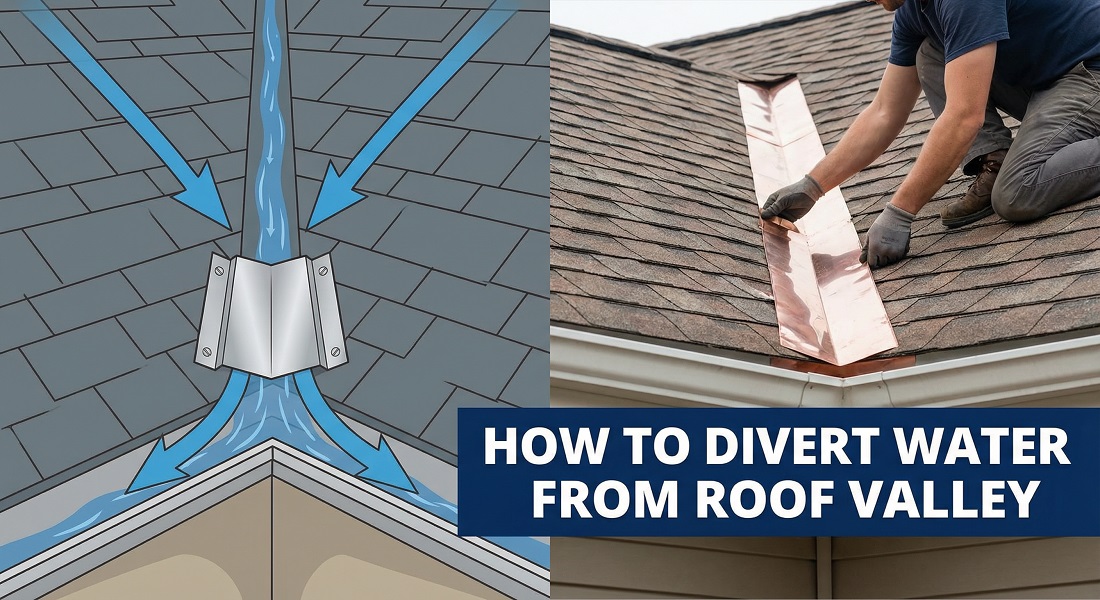
Method 1: Installing a Valley Splash Guard (For Valley-to-Lower-Roof Issues)
What this is: A metal deflector installed at the valley terminus that spreads concentrated water across a wider area.
When to use it: Valley ends above another roof section or structure and concentrated flow is overwhelming that area.
Materials needed:
- Sheet metal (aluminum or copper) 24-36 inches wide, 12-18 inches tall
- Metal snips or shears
- Roofing screws or nails
- Silicone or polyurethane sealant
- Metal bending brake (optional, can have sheet metal shop pre-bend)
Step-by-step installation:
1. Measure the valley width at terminus point. The splash guard needs to be 6-12 inches wider than the valley opening to catch all flow.
2. Cut and bend sheet metal to create a curved deflector. The shape should be a gentle curve (like a ski jump) that redirects water outward rather than letting it drop straight down. Bend angle is typically 30-45 degrees.
3. Position the splash guard at valley end. The top edge should overlap the valley flashing by 4-6 inches (goes under the last course of shingles). The curved deflector extends out and down past the eave edge.
4. Fasten securely to valley flashing and roof deck. Use screws or nails at top edge only (under shingles). Don’t penetrate the curved deflector section—it’s cantilevered.
5. Seal top edge where it meets valley flashing. Use silicone or polyurethane sealant to prevent water from getting behind the deflector.
6. Test with hose. Run water down valley and verify it spreads across the deflector and distributes to lower roof in a 3-4 foot wide area rather than concentrating.
Cost: $50-150 DIY for materials, $300-600 professional installation.
Effectiveness: Reduces concentrated flow impact by 60-80%, spreading load across wider area.
Method 2: Installing Oversized Gutter or Secondary Downspout at Valley
What this is: Upgrading gutter capacity at the valley collection point to handle concentrated flow volume.
When to use it: Valley water overshoots or overflows standard gutter during heavy rain.
Option A: Oversized Gutter Section
Replace standard 5-inch gutter with 6-inch or 7-inch section for 6-10 feet on either side of valley outlet. The larger cross-section handles higher flow volume without overflowing.
Step-by-step installation:
1. Remove existing gutter section where valley terminates (typically 6-10 feet centered on valley).
2. Install oversized gutter in that section. Use same material as existing (aluminum, steel, copper) but larger size. 6-inch K-style handles 40% more volume than 5-inch.
3. Use adapters or custom-bent end caps to transition from oversized section back to standard gutter on either side.
4. Ensure proper slope (1/4 inch per 10 feet minimum) toward downspout.
5. Install downspout at or near valley location if one isn’t already there. Concentrated flow needs direct path to ground.
Cost: $200-400 for 10-foot oversized section DIY, $500-900 professional installation.
Option B: Add Secondary Downspout
Keep existing gutter but add a second downspout at valley location to increase drainage capacity.
Step-by-step installation:
1. Cut outlet hole in gutter bottom directly below valley outlet point. Use hole saw sized for your downspout (typically 2.5-inch or 3-inch diameter).
2. Install drop outlet fitting. These crimp or screw to gutter and provide connection for downspout.
3. Attach downspout and route to ground, maintaining clearance from siding.
4. Install splash block or extension at ground level to direct water away from foundation.
Cost: $100-200 DIY, $250-450 professional installation per downspout.
Effectiveness: Eliminates overflow in 90%+ of cases by providing adequate drainage capacity for valley volume.
Method 3: Installing a Flow Spreader in Valley
What this is: A device installed in the valley that spreads water flow across a wider gutter section rather than letting it concentrate at one point.
When to use it: Valley dumps large volume into one 6-12 inch section of gutter, causing local overflow even though overall gutter capacity is adequate.
Commercial products available: Several manufacturers make plastic or metal valley flow spreaders. These install in the valley and have multiple outlet ports that distribute water across 3-4 feet of gutter.
DIY alternative:
1. Cut a piece of perforated metal or heavy mesh (hardware cloth, expanded metal) 36-48 inches long, 8-12 inches wide.
2. Bend to match valley angle so it sits flat in valley bottom.
3. Install at valley terminus (where valley meets gutter) with top edge under shingles, bottom edge extending into gutter.
4. Secure with screws or nails at edges only.
How it works: Water hits the perforated surface and spreads laterally before entering gutter, distributing across 3-4 feet of gutter rather than dumping at one point.
Cost: $40-80 DIY, $200-400 professional installation.
Effectiveness: Reduces localized gutter overflow by distributing load, but doesn’t increase total capacity—if gutter is undersized overall, you’ll still have issues.
Method 4: Installing a Cricket or Saddle to Split Valley Flow
What this is: A peaked structure built at the ridge that diverts water to either side, creating two separate flow channels rather than one concentrated valley.
When to use it: Chronic ice dam valley that resists other solutions, or poorly-designed valley with geometric problems that can’t be corrected.
This is professional-level carpentry. You’re building a small roof structure, framing it properly, sheathing it, and integrating it into the existing roof. Not a DIY project unless you’re an experienced carpenter.
General process:
1. Frame a peaked structure (like a miniature roof) that sits at the ridge where the valley starts. The peak divides water flow left and right.
2. Sheath the cricket with plywood or OSB.
3. Install ice/water shield and valley flashing on both sides of the cricket, creating two new mini-valleys.
4. Install shingles over the cricket, integrating with existing roof.
Effect: Instead of one valley channeling all water, you now have two smaller valleys handling half the volume each. This often eliminates ice dam formation and reduces concentrated flow issues.
Cost: $800-2,500 depending on size and complexity.
When this makes sense: Chronic problem valleys that have failed other solutions. Permanent fix for geometric issues.
Method 5: Installing Mid-Valley Scupper or Gutter
What this is: Installing a gutter or collection point partway down a long valley rather than making all water flow to the eave.
When to use it: Very long valleys (30+ feet), valleys with low pitch where water moves slowly, or valleys where lower section has drainage problems.
Process:
1. Identify the optimal collection point in the valley—typically where pitch decreases, where valley changes direction, or simply mid-point of a very long run.
2. Install a scupper box or small gutter section in the valley at that point. This is a metal box or trough that collects water flowing down the valley.
3. Route collected water via downspout through the roof structure to eave level or directly to ground if it’s a low roof.
4. Valley continues below the collection point but now handles only water from the lower roof section, not the entire valley length.
This requires cutting through roof structure to route the internal downspout. Professional work involving carpentry, waterproofing, and careful flashing details.
Cost: $1,200-3,500 depending on complexity and downspout routing.
Effectiveness: Dramatically reduces water volume in lower valley section. Useful for specific geometric challenges.
How to Install Proper Valley Drainage From Scratch (Re-Roof)
If you’re building new or completely replacing a roof, here’s how to set up valley drainage correctly from the start.
Step 1: Frame Valley with Adequate Pitch
Minimum pitch for valleys: 3:12 (3 inches of vertical drop per 12 inches horizontal). Prefer 4:12 to 6:12 for reliable drainage.
Valley rafter sizing: Minimum 2×8, prefer 2×10 for spans over 12 feet. Valley rafters carry load from two roof planes and need to be sized accordingly.
Check for straight run and consistent pitch: Use string line from ridge to eave along valley centerline. Any sag or low spot will cause water pooling.
Step 2: Install Double Underlayment or Ice/Water Shield
Code requirement: Two layers of underlayment in valleys, or one layer of ice/water shield membrane.
Installation sequence:
1. Install first layer of underlayment across valley area, extending 18 inches on each side of valley centerline.
2. Install second layer centered on valley, extending 18 inches each side, overlapping first layer.
Alternative: Install ice/water shield (Grace, Owens Corning WeatherLock) as single layer, 36 inches wide minimum, centered on valley.
This is your waterproofing. The valley flashing is the visible water channel, but underlayment is what actually keeps water out of the structure.
Step 3: Install Pre-Bent Metal Valley Flashing
Material selection:
- Aluminum: $3-6 per linear foot, 25-40 year lifespan, good corrosion resistance
- Galvanized steel: $2-4 per foot, 15-30 years, adequate for most climates
- Copper: $18-35 per foot, 50-100+ years, premium choice
Width: Minimum 18 inches wide (24 inches preferred for heavy water volume areas).
Installation process:
1. Start at eave and work toward ridge. Valley flashing installs in sections (typically 10-foot lengths).
2. Overlap sections 6 inches minimum with upper piece over lower (water flows over seam, not into it).
3. Fasten at edges only, 1 inch from edge, every 12 inches. Never nail through valley center—creates potential leak points.
4. Use nails or screws appropriate for metal type. Aluminum nails for aluminum flashing, stainless steel or copper for copper flashing. Mixing metals causes galvanic corrosion.
5. Trim at ridge. Valley flashing extends to ridge peak and is cut to fit under ridge cap.
Step 4: Install Shingles with Proper Valley Cuts
Open valley method (recommended):
1. Run shingles to valley edge, then cut at angle leaving 3-4 inch exposed metal channel down valley center (6-8 inches total width).
2. Cut angle should be 30-45 degrees from valley centerline, creating wider channel at bottom than top (helps flow).
3. Seal cut edges with roofing cement where shingle meets metal valley.
4. Never nail closer than 6 inches from valley centerline. Nails in or near valley channel create leak points.
Closed valley method:
1. Run shingles from one plane across valley and 12 inches up the opposite plane.
2. Run shingles from opposite plane, cutting them to overlap the first set with 1-2 inch offset from valley center.
3. Seal cut edges with roofing cement.
4. Ensure upper shingles overlap lower shingles (water flows over seam).
Step 5: Connect Valley to Gutter System
Gutter positioning: The gutter must catch water exiting the valley. Position gutter outlet (connection to downspout) at or near valley terminus for best drainage.
Gutter sizing: Size gutter for valley water volume. Standard 5-inch gutter adequate for valleys draining up to 1,200 square feet. Larger roof areas need 6-inch gutter or secondary downspout at valley.
Downspout capacity: Ensure downspout can handle volume. Standard 2×3 inch downspout handles 600 square feet roof area. 3×4 inch handles 1,200+ square feet. Valley concentrates flow—don’t undersized downspouts.
Step 6: Test Before Finishing
Before final roof completion, test valley drainage:
1. Run hose at ridge and flow water down valley at volume simulating heavy rain.
2. Verify water flows smoothly with no pooling or backup.
3. Check gutter collection—water should flow into gutter, not overshoot or miss.
4. Inspect for leaks from attic side if accessible.
Fix any issues before completing roof. Far easier to address problems during construction than after everything is finished.
The Real Solutions (Based on What’s Actually Wrong)
Problem: Debris Accumulation
This is 60-70% of valley issues. Leaves, pine needles, and organic debris pack into the valley, creating a dam.
The fix: Clean it out. Not complicated, not expensive, just maintenance that should’ve happened regularly.
How to clean valleys properly:
Set up ladder safely. Extension ladder should extend 3 feet above roof edge and be secured. If you’re not comfortable on ladders or the roof pitch is steep, hire someone for $75-150 rather than risking a fall.
Remove large debris by hand first. Branches, leaf clumps, anything you can grab. Drop into bucket or onto tarp on ground.
Use leaf blower to clear remaining debris. Start at ridge, blow toward eave. The debris flows downhill with air pressure. This clears pine needles and granules that are packed in.
Alternative: Shop vac if you prefer pulling debris up rather than blowing down. Works fine but takes longer.
Flush with hose to verify clear flow. Water should run fast with no hesitation or pooling.
Frequency: Twice yearly minimum (spring and fall). If you’ve got trees overhanging the roof, make it quarterly. Takes 30-45 minutes per cleaning.
Cost: Free if you DIY. $75-200 professional service as part of gutter/roof cleaning.
Prevention: Gutter guards reduce debris accumulation but don’t eliminate it. You still need to clean, just less often. Trimming overhanging branches back 6+ feet from roof reduces debris significantly.
Problem: Missing or Inadequate Underlayment
What this looks like: Water flows through valley fine, but you’re getting interior leaks along the valley line during rain.
The valley is moving water, but it’s infiltrating through gaps or inadequate waterproofing underneath the flashing.
Building code requires two layers of underlayment in valleys, or one layer of ice/water shield membrane. Older roofs often don’t have this. Budget roofers sometimes skip it.
The fix: Valley rebuild with proper underlayment.
This means pulling shingles back 12-18 inches on each side of valley, removing old flashing, installing ice/water shield or double underlayment layer, reinstalling flashing, and putting shingles back.
This is professional work. Valley waterproofing details matter, and mistakes create leaks that cause $3,000-8,000 interior damage. Hire experienced roofers.
Cost: $15-30 per linear foot installed. A 20-foot valley runs $300-600 for proper rebuild.
Materials: Ice/water shield (Grace, Owens Corning WeatherLock) costs $75-150 per roll covering 200 square feet. You need it running the full valley length and extending 12-18 inches on each side.
Problem: Damaged or Corroded Flashing
What this looks like: Rust stains running down from valley. Visible holes or corrosion in metal flashing. Leaks during rain even when valley appears to be draining.
Metal flashing has a finite lifespan. When it’s done, it’s done.
Flashing lifespan:
- Aluminum: 25-40 years
- Galvanized steel: 15-30 years (less in coastal areas)
- Copper: 50-100+ years
If your roof is approaching these ages and you’re seeing valley problems, flashing failure is likely.
The fix: Replace valley flashing.
Pull shingles, remove old flashing, install new pre-bent metal valley flashing (aluminum or copper), reinstall shingles with proper cuts and sealing.
Materials cost: Aluminum valley flashing runs $3-6 per linear foot. Copper is $18-35 per foot. For a 20-foot valley, materials run $150-250 (aluminum) or $400-700 (copper).
Professional installation: $18-35 per linear foot for aluminum, $45-80 per foot for copper including labor.
Should you DIY this? Only if you’ve installed valleys before. The fastening pattern, shingle cutting, and sealing details matter. Mistakes create leaks. Most homeowners are better off hiring this out.
Problem: Valley Pitch or Structural Sag
What this looks like: Visible low spot or sag in valley line. Water pools in the sag during rain instead of flowing to gutter.
This isn’t a flashing problem—it’s a framing problem. The valley rafter has sagged, is undersized, or was installed with inadequate pitch.
Common causes: Undersized valley rafters (should be 2×8 or 2×10, installer used 2×6). Structural settling over decades. Wood rot weakening valley support.
The fix: Structural repair from below.
Access attic and identify sagging valley rafter. Sister new rafter alongside old one to restore pitch, or replace the rafter entirely. Then rebuild valley from roof surface with proper underlayment and flashing.
Cost: $800-2,500 depending on attic access and complexity. Easy if you’ve got accessible attic space. Expensive if you need to remove finished ceiling to access framing.
This is definitely professional work. Structural roof repairs require understanding load paths and proper fastening. Not DIY territory.
Reality check: I did one of these last year on a 1960s ranch. Valley had sagged 1.5 inches over 50+ years. Homeowner kept trying to patch it with sealant, new shingles, different flashing. Nothing worked because the structure was wrong. Finally got called in, sistered new valley rafter, rebuilt valley properly. Cost $1,400 but solved leak that had caused $6,000 interior damage over the years.
Problem: Ice Dams (Cold Climates)
What this looks like: During winter, ice builds up in valley creating dam. Water backs up behind ice and infiltrates under shingles. You get interior leaks or icicles hanging from valley.
Why valleys are vulnerable: They’re typically north-facing (less sun to melt ice). Snow from two roof planes accumulates deep in valleys. Water concentrates and refreezes.
The real cause: Heat loss through attic melting snow on roof. Meltwater runs to cold valley and refreezes. This is an insulation and ventilation problem, not a valley problem.
Short-term fix: Heat cable in valley. Self-regulating electric heat cable installed in zigzag pattern keeps valley above freezing. Costs $8-15 per linear foot installed, uses $20-50 electricity per month when operating.
Long-term fix: Stop heat loss. Add attic insulation to R-49 to R-60 (climate dependent). Ensure balanced attic ventilation (ridge vent + soffit vents). Seal air leaks between living space and attic.
Costs: Insulation upgrade runs $1.50-3.00 per square foot. Ridge vent installation is $3-8 per linear foot. But this solves ice dams across your entire roof, not just valleys.
Emergency response: Don’t chip ice aggressively—you’ll damage shingles and flashing. Use calcium chloride ice melt (not rock salt) or hire ice dam steaming service ($300-800).
Prevention is cheaper than damage repair. Ice dam damage (interior water damage, destroyed gutters, ruined shingles) costs $5,000-15,000 to fix. Spending $2,000-4,000 on insulation and ventilation makes financial sense.
Maintenance That Actually Prevents Problems
Most valley failures are preventable with basic maintenance. Not complicated, not expensive—just consistent.
Spring cleaning (April/May): Remove winter debris accumulation. Inspect for winter damage (ice, snow weight, freeze-thaw). Verify no shingles lifted or damaged. Flush with hose to confirm clear flow.
Fall cleaning (October/November): Remove leaf accumulation before winter. Inspect flashing for corrosion or damage before ice/snow season. Check that all repairs from summer are solid.
Additional cleaning if needed: Heavy tree coverage requires quarterly cleaning. After severe storms, inspect for debris and damage. In high-pine-needle areas (pine, fir, spruce trees), monthly checks during needle drop season.
Annual professional inspection: Hire roofer to inspect full roof including valleys. They’ll catch issues (early corrosion, beginning underlayment failure, structural concerns) before they become leaks. Costs $150-300.
What this prevents: 60-70% of valley problems stem from debris accumulation and deferred maintenance. Basic cleaning eliminates most issues.
Cost comparison: $150-300 yearly for maintenance and inspection vs. $2,000-8,000 for interior water damage repair when valleys fail. Easy math.
What This Actually Costs (Real Numbers)
Maintenance:
- DIY valley cleaning: Free (your time, 30-60 min)
- Professional cleaning: $75-150 as part of roof service
- Annual inspection: $150-300
Minor Repairs:
- Replace damaged shingles near valley: $200-400
- Clean and reseal valley shingle cuts: $150-300
- Small flashing patch: $100-250
Major Repairs:
- Valley flashing replacement (aluminum): $360-700 for 20-foot valley
- Valley flashing replacement (copper): $900-1,600 for 20-foot valley
- Ice/water shield installation under existing valley: $240-400 for 20-foot valley
Structural:
- Valley rafter reinforcement: $800-2,500
- Complete valley rebuild with framing: $1,500-4,000
Valley Diversion Solutions:
- Splash guard installation: $50-150 DIY, $300-600 professional
- Oversized gutter section: $200-400 DIY, $500-900 professional
- Add secondary downspout: $100-200 DIY, $250-450 professional
- Flow spreader: $40-80 DIY, $200-400 professional
- Cricket/saddle installation: $800-2,500 professional only
- Mid-valley scupper/gutter: $1,200-3,500 professional only
Prevention:
- Heat cable for ice dams: $160-300 for 20-foot valley installed
- Attic insulation upgrade: $1.50-3.00 per square foot
- Gutter guards: $5-15 per linear foot installed
The pattern is clear: Maintenance is cheap. Prevention is moderate. Repairs after failure are expensive.
Bottom Line
Roof valleys don’t need help diverting water. They’re designed to handle massive flow. When they’re not working, it’s because:
Something is blocking them (debris—clean it out). They were installed wrong (fix the installation). Materials have failed (replace worn flashing/underlayment). Structure is inadequate (repair framing).
The “solution” isn’t diverting water differently. It’s removing the obstruction or fixing the failure so the valley works like it’s supposed to.
Exception: The rare situations where you legitimately need to redirect valley flow (valley-to-lower-roof issues, gutter overflow, ice dam splitting) have specific solutions—splash guards, oversized gutters, crickets—that address those particular geometric or capacity challenges.
Most valley problems cost $75-300 to prevent through regular maintenance. Ignoring them creates $2,000-8,000 repair bills. The math is simple.
Clean your valleys twice a year. Inspect annually. Address problems when they’re small. Your valleys will outlast your roof.