
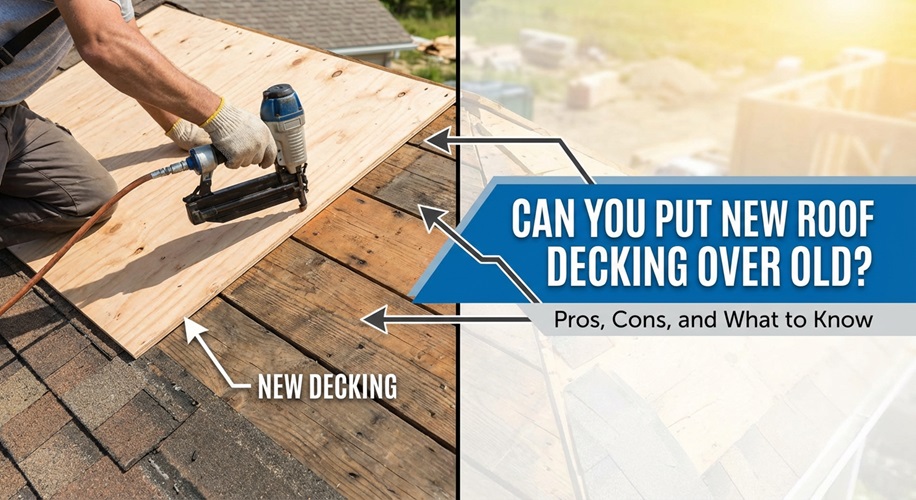
Yes, installing new roof decking over existing decking is structurally possible under specific conditions. However, this decision requires careful evaluation of the current deck’s integrity, local building code compliance, and long-term performance implications.
The roofing industry generally permits overlay installations when existing decking remains structurally sound, properly attached to rafters, free from rot or moisture damage, and capable of supporting additional weight. That said, overlay isn’t universally appropriate—and understanding when it works versus when full replacement becomes necessary separates successful roofing projects from costly failures.
This guide examines the technical requirements, decision criteria, installation protocols, and critical considerations every property owner and contractor should understand before choosing between overlay and replacement.
Understanding Roof Decking: Function and Importance
Roof decking—also called roof sheathing—serves as the structural foundation between your roofing materials and the underlying framing system. This layer performs several critical functions that directly impact your roof’s performance and longevity.
Structural Load Distribution
Decking transfers the weight of roofing materials, snow loads, maintenance personnel, and environmental forces to the rafter or truss system below. Compromised decking creates weak points where loads concentrate rather than distribute, potentially causing localized failure.
Nail Bed Foundation
Shingles, underlayment, and flashing require secure fastening to perform correctly. Decking provides the substrate into which these fasteners anchor. Deteriorated or thin decking allows nail pull-through, leading to shingle blow-offs and water infiltration.
Moisture Barrier Support
While underlayment provides the primary moisture barrier, decking must remain dimensionally stable and intact to support this layer properly. Warped, swollen, or rotted decking creates gaps and undulations where water can pool and penetrate.
Ventilation System Integration
Proper attic ventilation depends on decking installation that maintains required air gaps at soffits and ridges. Overlay installations must preserve these ventilation pathways to prevent moisture accumulation and premature material degradation.
When Overlay Makes Sense: Technical Criteria
Overlay installation becomes a viable option when existing conditions meet specific structural and regulatory requirements. Evaluate these criteria systematically before committing to this approach.
Structural Integrity Requirements
Attachment Security
Existing decking must remain firmly attached to all supporting rafters or trusses. Walk the roof surface carefully—any bouncing, flexing, or movement indicates compromised attachment requiring repair or replacement rather than overlay.
Surface Condition
The existing surface should be relatively flat and free from significant warping. Minor imperfections are acceptable, but pronounced waviness, cupping, or delamination prevents proper new deck installation and creates performance problems.
Fastener Holding Capacity
Test several areas by driving nails or screws into the existing deck. Proper holding requires resistance during installation and no pull-through under normal force. If fasteners pull through easily or the substrate crumbles around penetrations, overlay isn’t appropriate.
Absence of Decay and Damage
No Active Rot
Probe the existing deck in multiple locations, particularly around penetrations, valleys, eaves, and any areas showing staining or discoloration. Sound wood resists probe penetration firmly. Soft, spongy, or crumbling material indicates rot requiring removal.
No Pest Damage
Inspect for evidence of termite activity, carpenter ant damage, or other pest infestation. Hollow-sounding sections when tapped often indicate internal pest damage invisible from the surface. Affected areas require removal and treatment before any roofing work proceeds.
No Moisture Saturation
Current decking must be thoroughly dry. Moisture meters should read below 19% for wood-based products. Elevated moisture content indicates ongoing water intrusion requiring resolution before overlay installation. Trapping moisture beneath new decking accelerates deterioration of both layers.
Code Compliance Considerations
Maximum Layer Limits
Most building codes limit total roof covering layers—typically two layers of asphalt shingles on standard decking. Some jurisdictions extend this concept to decking layers. Verify local requirements before proceeding.
Weight Capacity
Adding decking layers increases dead load on the structure. Verify that rafters, trusses, and bearing walls can accommodate additional weight plus normal live loads (snow, maintenance access). Engineering evaluation may be required for older structures or heavy overlay materials.
Permit Requirements
Many jurisdictions require permits for re-roofing projects, including overlay installations. Permit applications may trigger inspections that identify code compliance issues requiring resolution.
When Full Replacement Becomes Necessary
Certain conditions make overlay inappropriate regardless of its cost or time advantages. Attempting overlay under these circumstances creates liability, accelerates deterioration, and ultimately costs more than proper replacement.
Conditions Requiring Complete Removal
Widespread Rot or Decay
When probe testing reveals soft or deteriorated wood across more than 15-20% of the roof area, overlay becomes impractical. The cost of spot repairs approaches full replacement, and hidden damage likely exists beyond visible areas.
Significant Structural Damage
Storm damage, fallen tree impacts, or long-term water infiltration affecting rafters or trusses beneath the deck requires full access for inspection and repair. Overlay conceals these conditions and allows progressive damage.
Active Water Infiltration
If the current deck shows ongoing moisture penetration—even from leaks you believe are fixed—full removal allows proper drying, damage assessment, and verification that repairs succeeded before installing new materials.
Code-Mandated Upgrades
Some jurisdictions require upgraded decking specifications for re-roofing projects. These may include thicker panels, higher-grade materials, or specific attachment methods impossible to achieve through overlay.
Ventilation System Deficiencies
When existing ventilation proves inadequate—evidenced by ice damming, condensation problems, or premature shingle failure—full deck removal allows ventilation system redesign and installation of proper intake and exhaust capacity.
Dimensional Changes
If you’re changing roofing materials significantly—particularly transitioning to heavier products like tile, slate, or metal—structural engineering assessment typically requires full deck removal for rafter or truss reinforcement.
Overlay vs. Replacement: Comprehensive Comparison
Understanding the full implications of each approach enables informed decision-making aligned with your priorities, budget, and long-term ownership plans.
Cost Analysis
Overlay Installation
| Cost Component | Typical Range |
|---|---|
| New decking materials (OSB or plywood) | $0.75-1.50 per sq ft |
| Labor for installation | $1.00-2.00 per sq ft |
| Fasteners and accessories | $0.15-0.25 per sq ft |
| Total overlay cost | $1.90-3.75 per sq ft |
Full Replacement
| Cost Component | Typical Range |
|---|---|
| Tear-off labor | $1.00-2.00 per sq ft |
| Disposal fees | $0.50-1.00 per sq ft |
| New decking materials | $0.75-1.50 per sq ft |
| Installation labor | $1.00-2.00 per sq ft |
| Fasteners and accessories | $0.15-0.25 per sq ft |
| Total replacement cost | $3.40-6.75 per sq ft |
Cost differential: Overlay typically saves 40-50% compared to full replacement when existing conditions permit.
Time Requirements
| Project Phase | Overlay | Replacement |
|---|---|---|
| Preparation and setup | 2-4 hours | 2-4 hours |
| Old material removal | Not required | 4-8 hours (typical home) |
| Deck installation | 4-8 hours | 4-8 hours |
| Roofing material installation | Standard time | Standard time |
| Cleanup and disposal | Minimal | 2-4 hours |
| Total time savings | 6-12 hours | Baseline |
Long-Term Performance Implications
Overlay Advantages
- Preserved existing structural attachment points
- Additional thickness may improve fastener holding
- Existing deck provides secondary protection layer
- Lower immediate cost preserves capital
Overlay Disadvantages
- Hidden deterioration continues unseen
- Reduced inspection access during future projects
- Potential moisture trapping between layers
- Increased dead load on structure
- May complicate future insurance claims
Replacement Advantages
- Complete damage assessment and resolution
- Fresh attachment to structural members
- Single known-condition layer
- Full code compliance verification
- Clean slate for warranty purposes
Replacement Disadvantages
- Higher immediate cost
- Longer project duration
- More intensive labor requirements
- Greater disposal volume and cost
Material Selection for Overlay Projects
When overlay is appropriate, material selection significantly impacts performance, durability, and compatibility with existing conditions.
Plywood Options
CDX Plywood (Exterior Grade)
Standard construction-grade plywood suitable for most overlay applications. The “X” designation indicates exterior glue resistant to moisture exposure during construction.
| Specification | Recommendation |
|---|---|
| Thickness | 1/2″ minimum (5/8″ or 3/4″ preferred) |
| Span rating | Match or exceed existing deck rating |
| Grade | CDX or structural 1 |
Advantages:
- Consistent strength in all directions
- Excellent nail-holding capacity
- Dimensional stability
- Long track record in roofing applications
Disadvantages:
- Higher cost than OSB
- Heavier weight per panel
- Availability variations in some regions
OSB (Oriented Strand Board) Options
Standard OSB
Engineered wood product composed of compressed strand layers bonded with waterproof adhesive. Widely used in new construction and re-roofing projects.
| Specification | Recommendation |
|---|---|
| Thickness | 7/16″ minimum (1/2″ or thicker preferred for overlay) |
| Span rating | 24/16 minimum |
| Edge treatment | Sealed or wrapped edges preferred |
Advantages:
- Lower cost than plywood
- Uniform consistency without voids
- Large panel availability
- Good span capability
Disadvantages:
- More susceptible to edge swelling when wet
- Slower drying when moisture-exposed
- Potentially lower nail-holding in thin sections
Specialty Decking Products
Radiant Barrier Sheathing
OSB or plywood with factory-applied radiant barrier facing. Reduces heat transfer into attic space, improving energy efficiency.
Best applications:
- Hot climate regions
- Poorly insulated attic spaces
- Metal roofing installations
Fire-Resistant Decking
Gypsum-core or fiber cement panels meeting specific fire ratings. Required in some wildfire-prone areas and for certain occupancy classifications.
DensGlass or Similar Products
Fiberglass-faced gypsum panels resistant to moisture and mold. Used in specific commercial applications and some residential fire-resistance assemblies.
Professional Installation Protocol
Proper overlay installation follows systematic procedures ensuring structural integrity, weather protection, and code compliance.
Phase 1: Preparation and Assessment
Complete Roof Inspection
Before any material ordering or scheduling, thoroughly evaluate existing conditions:
- Walk the entire roof surface, noting any soft spots, movement, or unusual deflection
- Probe representative areas in multiple roof zones
- Inspect from the attic side for visible damage, water staining, or light penetration
- Photograph all areas of concern
- Document existing deck thickness, type, and attachment pattern
- Verify rafter or truss spacing and condition
Remove Existing Roofing Materials
Overlay refers to decking-over-decking installation—not shingle-over-shingle or underlayment layering:
- Strip all existing shingles, underlayment, and flashing
- Remove protruding nails or fasteners
- Clean debris from the existing deck surface
- Identify and mark any areas requiring repair before overlay
Repair Compromised Sections
Address localized damage before proceeding:
- Cut out and replace rotted sections
- Re-secure any loose deck panels
- Fill significant gaps or holes
- Ensure relatively planar surface for new deck installation
Phase 2: New Deck Installation
Layout Planning
Proper panel layout maximizes structural performance:
- Stagger joints minimum 4 feet from underlying panel joints
- Align panel edges perpendicular to rafters
- Start at eave edge, working toward ridge
- Maintain 1/8″ gap between panel edges for expansion
Attachment Requirements
Secure fastening prevents future problems:
| Fastener Type | Spacing – Panel Edges | Spacing – Intermediate |
|---|---|---|
| 8d common nails | 6″ maximum | 12″ maximum |
| #8 screws (2″) | 6″ maximum | 12″ maximum |
| Ring-shank nails | 6″ maximum | 12″ maximum |
Critical attachment notes:
- Fasteners must penetrate into rafters—not just through two deck layers
- Pre-drill if splitting occurs near panel edges
- Set fastener heads flush, not countersunk deeply
- Verify fastener length accommodates both deck layers plus 1.5″ rafter penetration
Edge and Opening Details
Pay particular attention to critical areas:
- Eaves: Maintain proper overhang dimension for gutter attachment
- Rakes: Align edges precisely for clean fascia installation
- Valleys: Ensure smooth transition across valley framing
- Penetrations: Cut clean openings for vents, pipes, and skylights
- Ridge: Provide flat surface for ridge cap installation
Phase 3: Weather Protection and Roofing
Ice and Water Shield Application
Apply self-adhering membrane in vulnerable areas:
- Minimum 24″ beyond interior wall line at eaves (36″ in severe climate zones)
- Full coverage in valleys
- Around all penetrations
- At roof-to-wall transitions
Underlayment Installation
Cover remaining deck area with appropriate underlayment:
- Synthetic underlayment preferred for overlay projects (lies flatter, less wrinkling)
- Minimum 4″ side laps, 6″ end laps
- Fasten securely to prevent wind lifting before shingle installation
Shingle and Flashing Installation
Proceed with standard roofing installation practices appropriate for your selected materials. The overlay deck layer should be treated identically to new construction at this stage.
Building Code and Permit Considerations
Regulatory compliance protects property owners and ensures safe, durable installations.
Typical Code Requirements
International Residential Code (IRC) Provisions
The IRC, adopted with modifications in most U.S. jurisdictions, addresses roof sheathing in several sections:
- Section R803: Roof sheathing requirements
- Section R905: Roof covering requirements including re-roofing
- Section R806: Roof ventilation requirements
Common Requirements:
| Specification | Typical Requirement |
|---|---|
| Minimum deck thickness | 7/16″ OSB or 3/8″ plywood |
| Maximum rafter spacing | 24″ o.c. for standard materials |
| Edge support | H-clips or blocking at unsupported edges |
| Fastening | Specific nail type/spacing per material |
Permit Process
When Permits Are Required
Most jurisdictions require permits for:
- Complete roof replacement projects
- Structural modifications to roof framing
- Projects exceeding certain square footage thresholds
- Work requiring inspections
Permit Application Typically Requires:
- Property address and owner information
- Contractor licensing information
- Project description and scope
- Material specifications
- Site plan or roof diagram
- Permit fees (typically $100-500 for residential)
Inspection Expectations
Overlay projects may trigger inspections covering:
- Existing deck condition verification
- New deck attachment
- Underlayment and flashing installation
- Final roofing installation
Insurance Implications
Policy Considerations
Before proceeding with overlay installation, consider:
- Does your policy require specific roofing standards?
- Will overlay installation affect claim processing?
- Are there approved contractor requirements?
- What documentation should you retain?
Documentation Recommendations
Maintain records of:
- Pre-project inspection reports and photos
- Material specifications and receipts
- Permit and inspection records
- Contractor licensing and insurance certificates
- Warranty documentation
- Final inspection approval
Maintenance Protocols for Overlay Installations
Proper maintenance maximizes the service life of overlay deck systems and identifies problems before they become serious.
Regular Inspection Schedule
Biannual Inspections
Conduct thorough inspections in spring and fall:
- Walk the roof surface (safely) noting any changes in feel or appearance
- Check for shingle damage, missing granules, or lifting
- Examine flashings for separation or deterioration
- Clear debris from valleys and around penetrations
- Verify gutters and downspouts function properly
- Inspect from attic for any new staining or light penetration
After Severe Weather
Following significant storms:
- Visual inspection from ground level
- Check for obvious damage
- Document any concerns for insurance purposes
- Arrange professional inspection if damage suspected
Addressing Identified Issues
Minor Problems
Address promptly to prevent escalation:
- Replace missing or damaged shingles
- Reseal lifted flashing edges
- Clear blocked gutters or drains
- Trim overhanging vegetation
Significant Concerns
Engage qualified professionals for:
- Multiple areas of damage
- Evidence of water infiltration
- Structural deflection or movement
- Ventilation problems
Lifespan Expectations
Overlay System Longevity
Properly installed overlay systems should provide:
| Component | Expected Service Life |
|---|---|
| Decking layers | 40-60 years |
| Asphalt shingles | 20-30 years |
| Underlayment | 25-30 years |
| Flashing (metal) | 30-50 years |
Factors Affecting Longevity:
- Quality of existing deck condition at overlay
- Installation workmanship
- Climate severity
- Maintenance frequency
- Ventilation adequacy
Common Mistakes and How to Avoid Them
Learn from frequent errors that compromise overlay installations.
Mistake #1: Inadequate Existing Deck Evaluation
The Problem:
Rushing into overlay without thorough assessment traps moisture, conceals active damage, and creates liability.
The Solution:
Invest time in comprehensive evaluation:
- Probe testing across entire roof area
- Moisture meter readings in suspect zones
- Attic-side inspection with adequate lighting
- Professional evaluation for uncertain conditions
Mistake #2: Improper Fastener Selection
The Problem:
Standard fasteners that worked for single-deck installation may not penetrate adequately through two deck layers into rafters.
The Solution:
- Calculate required fastener length: existing deck thickness + new deck thickness + 1.5″ rafter penetration minimum
- Use ring-shank or screw fasteners for improved holding
- Verify rafter locations before fastening
Mistake #3: Ignoring Ventilation Requirements
The Problem:
Overlay installation that blocks or reduces ventilation causes moisture accumulation, ice damming, and premature material failure.
The Solution:
- Maintain all existing soffit vent openings
- Preserve ridge ventilation capacity
- Consider adding ventilation if current system proves inadequate
- Calculate net free area requirements for roof size
Mistake #4: Insufficient Edge Gap Allowance
The Problem:
Butting panels tightly together prevents natural expansion, causing buckling, waviness, and fastener stress.
The Solution:
- Maintain 1/8″ gap between panel edges
- Use spacer clips or nails during installation
- Allow 1/4″ gap at walls and other vertical surfaces
Mistake #5: Skipping Underlayment
The Problem:
Assuming two deck layers eliminate the need for underlayment. Both layers remain vulnerable to moisture intrusion without proper secondary weather barrier.
The Solution:
- Install complete underlayment system per manufacturer specifications
- Use ice and water shield in all vulnerable areas
- Don’t shortcut this critical protection layer
Frequently Asked Questions
How do I know if my existing decking can support an overlay?
Conduct systematic evaluation: walk the roof checking for movement or soft spots, probe multiple areas testing for solid wood resistance, inspect from the attic for visible damage or staining, and use a moisture meter to verify dryness below 19%. If any section shows decay, moisture saturation, or structural compromise, that area requires replacement rather than overlay. When uncertainty exists, engage a structural engineer or experienced roofing contractor for professional assessment.
Will adding another layer of decking void my roofing warranty?
Most shingle manufacturers require installation over code-compliant decking but don’t specifically prohibit overlay on structurally sound existing decks. However, warranty requirements vary by manufacturer and product line. Review specific warranty documentation before proceeding. Some manufacturers require minimum deck thickness, specific panel types, or particular attachment methods. Maintain all documentation demonstrating compliance with manufacturer specifications.
How much additional weight does overlay add to my roof structure?
Typical overlay installation adds 1.5-2.5 pounds per square foot depending on material selection. For a 2,000 square foot roof, this equals 3,000-5,000 pounds of additional dead load. Most modern residential structures can accommodate this additional weight, but older homes, those in heavy snow regions, or structures with span-limited framing may require engineering verification before overlay installation.
Can I install metal roofing over existing decking with an overlay?
Metal roofing installation over overlay decking is possible and sometimes advantageous. The additional deck layer provides improved fastener holding and a smoother substrate. However, metal roofing systems vary significantly—some install directly over old shingles, others require complete deck exposure, and some demand specific underlayment or substrate requirements. Consult your selected metal roofing manufacturer’s installation specifications for their requirements.
What’s the minimum thickness recommended for overlay decking?
For overlay applications, use minimum 7/16″ OSB or 1/2″ plywood. Thicker materials (15/32″ or 1/2″ OSB, 5/8″ or 3/4″ plywood) provide improved performance, better fastener holding, and greater span capability. The incremental cost of thicker material is minimal compared to total project investment and provides measurable performance improvement.
How long should the existing deck have been in place before overlaying?
The age of existing decking matters less than its current condition. A 5-year-old deck with water damage is unsuitable for overlay, while a 30-year-old deck in excellent condition may be perfectly appropriate. Evaluate based on physical inspection results rather than installation date. That said, very new decking (under 2-3 years) rarely requires overlay unless damage has occurred.
Does overlay installation affect resale value or home inspections?
Professional home inspectors may note overlay installations in their reports. This documentation isn’t inherently negative if the installation was properly executed on sound existing decking. Maintain records demonstrating proper assessment and installation practices. Some buyers or their inspectors may view overlay unfavorably compared to complete replacement—this perception varies by market and buyer sophistication.
Can I do a partial overlay on just damaged sections?
Partial overlay creates transition challenges where new and old deck surfaces meet at different elevations. This approach is generally discouraged. Instead, cut out and replace damaged sections with matching thickness material, bringing the entire roof to a consistent single-deck plane. If damage is extensive enough to consider overlay, full-roof overlay typically provides better results than patchwork approaches.
Making the Right Decision
Choosing between overlay and replacement requires balancing technical factors, financial considerations, and long-term ownership plans.
Choose overlay when:
- Existing decking is structurally sound throughout
- No evidence of rot, moisture damage, or pest activity
- Local codes permit overlay installation
- Budget constraints make replacement difficult
- You plan to sell the property within 10-15 years
Choose replacement when:
- Significant portions show decay or damage
- Active water infiltration has occurred
- Structural concerns exist about additional weight
- You want maximum service life from the investment
- The property will remain in your ownership long-term
Engage professional evaluation when:
- Any uncertainty exists about existing conditions
- The roof has experienced significant weather events
- Previous leak history exists
- The structure is older or has unknown construction quality
Final Recommendations
Installing new roof decking over existing decking represents a legitimate, cost-effective approach when conditions permit. Success depends on honest assessment of existing conditions, proper material selection, correct installation practices, and appropriate maintenance.
Essential steps for successful overlay:
- Conduct thorough evaluation before committing to approach
- Address all damage, decay, or moisture issues first
- Select appropriate materials matching or exceeding existing specifications
- Follow proper installation protocols including attachment patterns
- Install complete weather protection systems
- Maintain documentation for warranty and insurance purposes
- Implement regular inspection and maintenance programs
The overlay decision ultimately balances immediate cost savings against potential long-term implications. When existing conditions genuinely support this approach, overlay delivers excellent value. When conditions don’t support overlay, attempting it anyway creates expensive problems far exceeding the cost of proper replacement.
Invest the evaluation time upfront. Make informed decisions based on actual conditions rather than assumptions. Execute with proper materials and techniques. The result will be a durable, weather-resistant roof system serving your property for decades.